
Story 36
Lou-Anne and the Buried Treasure
10 minute read · Mystery and problem-solving
It started with a box.
Not a shiny treasure chest, not at first. Just an old wooden box tucked away on a high shelf in Omi and Opi’s little storeroom, beneath a pile of folded picnic blankets and one very dusty lantern.
Lou-Anne had only gone in to look for string.
Instead, she found history.
“Omi!” she called. “What’s this?”
Omi came to the doorway, wiped her hands on her apron, and smiled when she saw the box. “Well now,” she said. “I haven’t seen that in years.”
Opi appeared behind her. “Open it.”
Inside the box were old postcards, a compass with a cracked glass face, two smooth stones wrapped in cloth, and a folded piece of paper yellowed with age.
Lou-Anne lifted it carefully.
“It’s a map,” she whispered.
At once, Marmalade jumped onto the table. Pinky appeared from nowhere, because maps and secrets apparently concern him deeply. Lilo arrived two seconds later with the face of someone prepared to judge the entire process.
M’Pofo peeked through the doorway. “Did someone say map?”
Vakawu practically fell in through the window. “Treasure map?”
Ubejane, from outside, muttered, “This is how people end up in holes.”
The paper crackled as Lou-Anne opened it.
Drawn in faded ink was a rough map of the Savannah near Omi and Opi’s home. There was the lake. The old fig tree. The split rock near the path. And there, marked with a large X beside a sketch of three termite mounds, were the words:
Where the morning sun touches the tallest stone, the treasure waits below.
Lou-Anne’s eyes went wide. “Opi… is this real?”
Opi scratched his chin. “It belonged to an old friend of my grandfather’s. He always claimed he buried something valuable and left clues for the clever to find.”
Vakawu threw both arms into the air. “At last. My destiny.”
“Your destiny,” said Lilo, “usually involves falling off things.”
Omi laughed. “Whether it’s treasure or not, it looks like an adventure.”
“That,” said Lou-Anne, folding the map carefully, “is exactly what we’re having.”
The next morning, the whole gang set off early.
Lou-Anne carried the map in her satchel. M’Pofo carried a shovel tied gently with rope across his back. Ubejane insisted he did not care about treasure in the slightest, while walking exactly in line with everyone else. Vakawu had already appointed himself Chief Clue Expert. Kiera bounced ahead scouting the ground, and Marmalade, Pinky, and Lilo followed in a neat row like a suspicious little treasure committee.
They reached the old fig tree first.
“According to the map,” Lou-Anne said, “we go past the fig tree, then the split rock, then find three termite mounds.”
“Easy,” said Vakawu.
It was not easy.
They found five termite mounds.
Then seven.
Then one that turned out to be only a very ambitious bush.
“This map is rude,” said Pinky.
M’Pofo shaded his eyes with his trunk. “There. Three together, near that tall stone.”
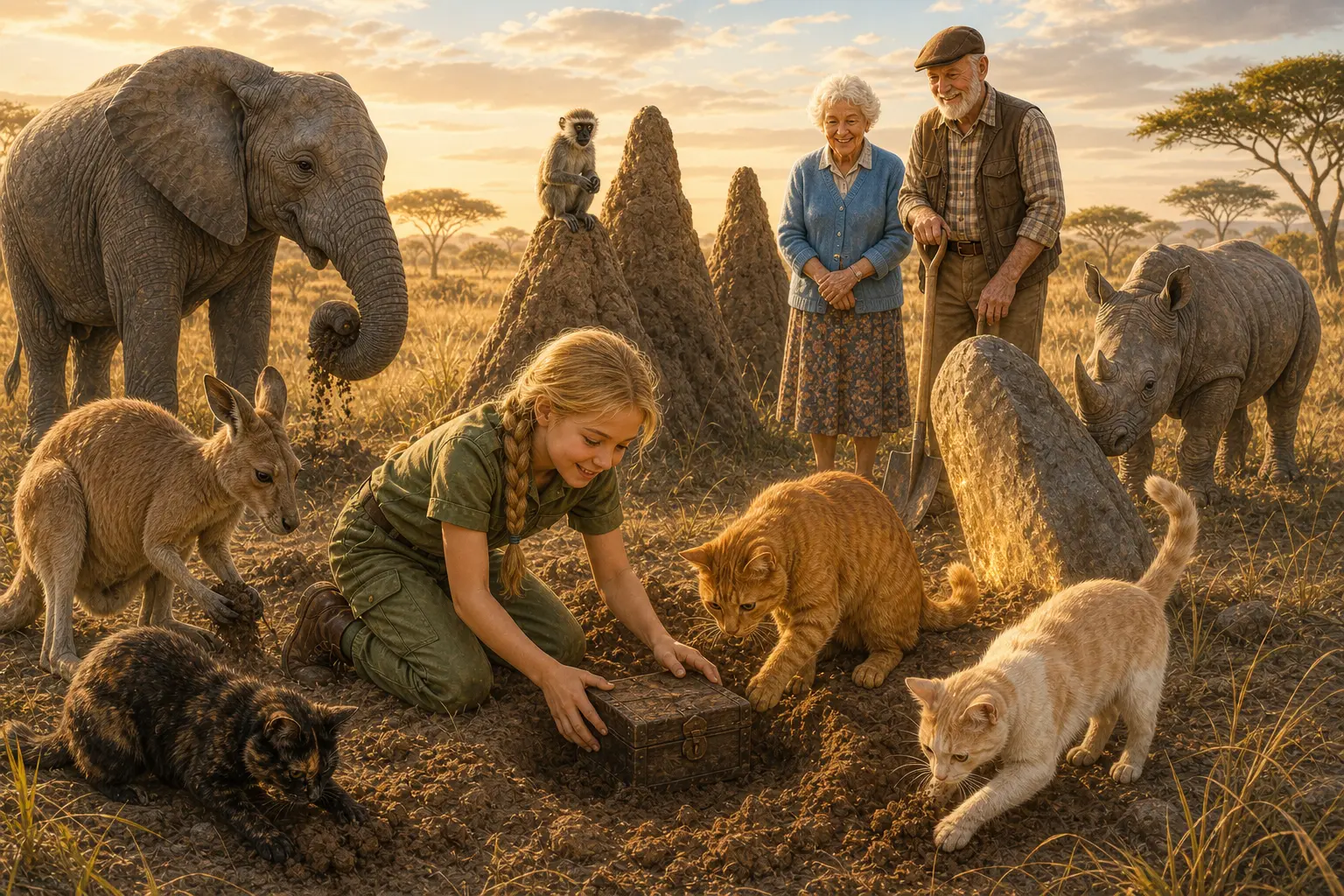
Sure enough, on a rise overlooking the grass stood three termite mounds clustered beside one long grey stone leaning slightly to one side.
Lou-Anne unfolded the map again. “Where the morning sun touches the tallest stone…”
They all looked.
The sun was climbing and its light fell directly on the top of the leaning stone, making it glow pale gold.
“This is it,” said Lou-Anne.
The digging began.
Lou-Anne and Opi used the shovel first, loosening the earth at the base of the stone. M’Pofo helped lift out clumps of dirt with careful sweeps of his trunk. Kiera used her paws to scrape loose soil aside. Vakawu dug for thirty seconds, announced it was exhausting, and climbed onto a mound to supervise.
Ubejane, who definitely did not care, used one strong foot to shove a heavy stone out of the way.
After a while, Marmalade suddenly froze.
He stared at a patch of ground and gave one sharp meow.
“What is it?” Lou-Anne asked.
Marmalade pawed at the earth.
Pinky joined him and began scraping delicately. Lilo, with visible reluctance, added two neat scoops of soil.
Then they all heard it.
Clunk.
Everyone went still.
M’Pofo’s ears lifted. “That was not a rock.”
Lou-Anne dropped to her knees and brushed the dirt aside with both hands.
Something wooden lay buried just below the surface.
“A box!” cried Kiera.
“A treasure chest,” Vakawu corrected, despite it being approximately the size of a lunch tin.
They carefully lifted it out. It was old and dark with age, bound with little strips of metal and closed with a rusted latch.
Lou-Anne looked at Omi and Opi. “Should I open it?”
Omi smiled. “You found it.”
So Lou-Anne opened the latch.
Inside was not gold.
Not jewels.
Not crowns or pearls or pirate nonsense.
Inside were smaller treasures.
There was a tiny silver whistle. A carved wooden giraffe no taller than Lou-Anne’s hand. A string of bright beads. A brass key. A bundle of old coins. And underneath it all, wrapped in cloth, was a little notebook.
Lou-Anne opened it gently.
On the first page was written:
For the one who finds this treasure:
These are small things, but each one tells a story.
Treasure is not always what shines the most.
Sometimes it is what is remembered.
Everyone fell quiet.
Lou-Anne turned the pages. The notebook was filled with little notes about each object. The whistle had belonged to a shepherd boy. The beads had been traded at the lakeside market. The carved giraffe had been made by hand for a child on her birthday. The key no longer opened anything, but once fit a travelling chest that crossed half the country.
“It’s a memory treasure,” Lou-Anne said softly.
Omi nodded. “That may be better than gold.”
Vakawu tilted his head. “Gold would still be nice.”
Ubejane snorted. “You cannot eat gold. Or whistle with it.”
“I don’t think that’s the point,” said Lou-Anne, smiling.
They carried the treasure box back home and spent the afternoon under the baobab tree reading the notebook together.
Opi told them what he knew about the places mentioned in the pages. Omi polished the little whistle until it shone. M’Pofo held the carved giraffe so carefully it looked as though he were holding a raindrop. Kiera wore the beads for five minutes and then gave them back at once when Lilo stared at her in horror.
Marmalade curled up beside the treasure chest, pleased with himself.
“You did help find it,” Lou-Anne told him.
He purred as if this had been obvious from the start.
As the sun sank lower, Lou-Anne placed the notebook back inside the box.
“I think,” she said, “the treasure should stay with us, but not hidden away. We should keep it safe and tell its stories properly.”
Omi smiled. “That is exactly what real treasure is for.”
Vakawu leaned back against the baobab. “So the adventure ends with reading.”
“The best adventures often do,” said Lou-Anne.
Ubejane looked at the little chest and gave a slow nod. “Acceptable treasure.”
High praise indeed.
And so the buried treasure became part of their home, not because it was worth a fortune, but because it reminded them that the most valuable things are often the ones that carry stories, memories, and the hands of those who came before.
Which, Lou-Anne thought as the evening wind moved softly through the grass, was the best treasure of all.