Story 60
Lou-Anne and the Capybara Who Painted the Savannah
16 minute read · Creativity, resilience and trying new things
It was a lovely spring morning on the African Savannah. M’Pofo, the young elephant, was standing beneath his favourite baobab tree, carefully mixing colours in three enormous clay pots.
Lou-Anne was sitting beside him with a paintbrush in her hand.
“More yellow, M’Pofo,” she instructed. “We need a lovely bright orange for the sunset.”
M’Pofo dipped his trunk into the yellow paint and gave the pot a good stir.
Unfortunately, he stirred a little too enthusiastically.
SPLAT!
A large blob of orange paint landed directly on Ubejane’s nose.
The grumpy old rhinoceros, who had been enjoying a peaceful morning nap, opened his eyes.
“M’POFO!”
“Oh dear,” said M’Pofo.
Lou-Anne burst out laughing.
“You look like a rhinoceros with a giant orange carrot stuck to his face!”
Ubejane was not amused.
“I am a black rhinoceros, not a vegetable!”
Just then, Vakawu, the very clever vervet monkey, swung down from the branches.
“I rather like it,” he announced. “It makes you look younger.”
Ubejane gave him a look that suggested Vakawu would be considerably safer back in his tree.
The friends had decided to spend the day painting a beautiful picture of their Savannah. Lou-Anne wanted to paint the baobab, the waterhole, the distant hills and all her animal friends.
But there was one problem.
They had plenty of paint and brushes, but nobody could agree on what to paint first.
“I think we should paint a magnificent elephant,” said M’Pofo.
“A very handsome monkey,” suggested Vakawu.
“A rhinoceros without orange paint on his nose,” grumbled Ubejane.
Before Lou-Anne could settle the argument, a strange voice came from behind the tree.
“Excuse me, does anybody know where I might find some water?”
Everyone turned around.
Standing beside the baobab was the strangest animal Lou-Anne had ever seen.
He had a large, round body, short legs, little ears and a broad, rather serious-looking nose. His brown fur was still wet, and he was carrying a bundle of reeds in his mouth.
“Goodness!” exclaimed Lou-Anne. “Who are you?”
The animal dropped his reeds.
“My name is Paco. I’m a capybara.”
Vakawu scratched his head.
“A what?”
“A capybara.”
“Are you a giant guinea pig?”
Paco considered this.
“Well, we are related.”
Vakawu’s eyes widened.
“A GIANT GUINEA PIG!”
Ubejane sighed.
“Must you shout everything?”
Paco explained that he came from South America, where capybaras lived beside rivers, lakes and marshes. He had travelled a very long way with a group of animal explorers and had become separated from them while investigating the Savannah.
“I was following a stream,” he said, “but it disappeared into the sand. Now I’m terribly thirsty.”
M’Pofo immediately offered to help.
“Climb onto my back, Paco. I’ll take you to our waterhole.”
Paco looked at the enormous elephant.
“Are you sure?”
“Certainly!”
Paco climbed onto M’Pofo’s back with Lou-Anne’s help.
Vakawu jumped up beside him.
“Tell me, Paco, do all capybaras look like enormous potatoes?”
Paco looked thoughtfully at the monkey.
“Do all vervet monkeys ask so many questions?”
“Only the clever ones.”
“Then yes,” said Paco, “all capybaras look like potatoes.”
Lou-Anne laughed so much that she nearly dropped her paintbrush.
A Most Unusual Artist
When they reached the waterhole, Paco immediately slipped into the cool water.
He swam beautifully, with only his eyes, ears and nose showing above the surface.
M’Pofo watched in admiration.
“You’re a very good swimmer.”
“Thank you,” replied Paco. “We capybaras have partly webbed feet. They help us swim.”
Vakawu inspected his own feet.
“Mine are excellent for climbing.”
Ubejane looked at him.
“And occasionally falling.”
Paco climbed out of the water and shook himself.
Lou-Anne had brought her painting materials along, and she began setting up beneath a shady Mopani tree.
Paco watched with great interest.
“What are you doing?”
“Painting,” answered Lou-Anne. “Would you like to try?”
“I’ve never painted before.”
“That doesn’t matter. I can show you.”
She handed Paco a large brush.
Unfortunately, capybaras do not have hands like humans or monkeys.
Paco tried holding the brush between his front paws.
It fell over.
He tried gripping it in his mouth.
The bristles tickled his nose.
“Aaah... aaah... ACHOO!”
The brush shot across the clearing and landed in Vakawu’s lap.
Vakawu looked down.
A bright blue streak now decorated his stomach.
“Wonderful!” he exclaimed. “I’ve become a work of art!”
Buhala, the banded mongoose, had arrived just in time to see the commotion.
“You look like you fell into a bucket,” she told him.
“That is a very uneducated artistic opinion.”
Lou-Anne thought for a moment.
“Perhaps you don’t need a brush, Paco.”
She dipped a broad, flat leaf into green paint and pressed it onto a piece of bark.
When she lifted it, the leaf had left a beautiful pattern.
“See? You can paint with all sorts of things.”
Paco looked down at his large feet.
“Even these?”
“Certainly!”
Lou-Anne spread some yellow paint on a flat stone.
Paco carefully stepped into it.
Then he walked across a large piece of cloth that M’Pofo had stretched between two trees.
Four beautiful yellow footprints appeared.
Paco looked delighted.
“I’m painting!”
He walked across the cloth again.
And again.
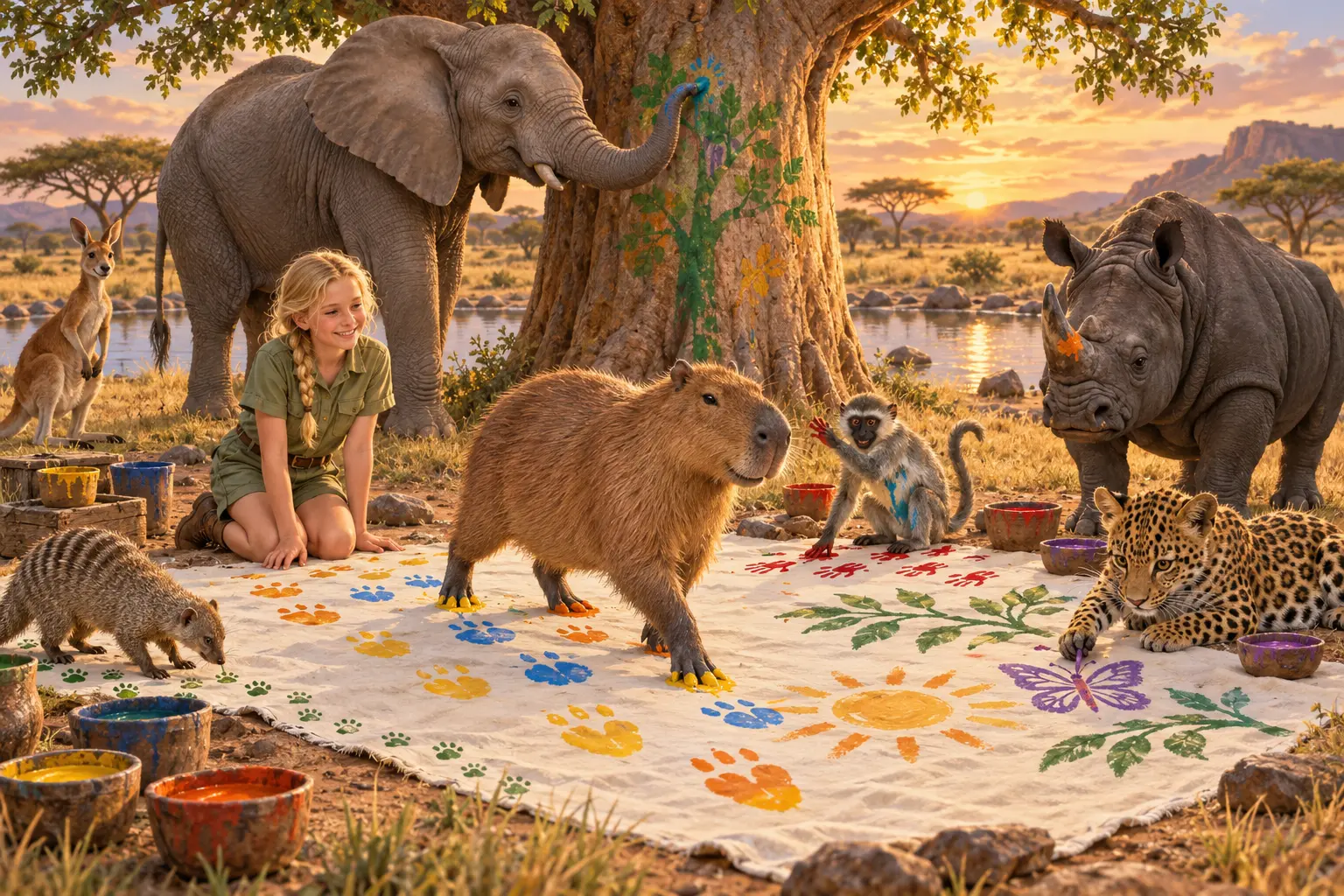
Soon there were yellow, orange and blue footprints everywhere.
Vakawu decided he wanted to try too.
He dipped his hands into red paint and began making handprints.
Buhala used her tiny paws to make little patterns around the edges.
M’Pofo dipped the tip of his trunk into green paint and drew the enormous branches of a baobab tree.
Even Ubejane joined in, although he insisted he was merely supervising.
He dipped the tip of his horn into black paint and drew a surprisingly good rhinoceros.
Lou-Anne stared at it.
“Ubejane! That’s wonderful!”
The old rhino looked rather pleased.
“Well, naturally. I have an excellent horn for fine details.”
Vakawu examined the painting.
“Your rhinoceros has four legs.”
“Most rhinoceroses do.”
“Mine would have six. Much more interesting.”
“Then it would not be a rhinoceros!”
The Great Painting Disaster
By lunchtime, the friends had created an enormous and colourful picture.
There was a green baobab, a blue waterhole, orange mountains and dozens of animal footprints.
Paco had added a large brown shape in the middle.
“What is that?” asked Lou-Anne.
“A capybara.”
Vakawu tilted his head.
“It looks like a loaf of bread.”
“A very handsome loaf of bread,” replied Paco.
Just then, Nia the leopard arrived.
She had been hunting butterflies among the tall grasses and was delighted to see her friends.
“What are you all doing?”
“Painting!” shouted everyone.
Nia inspected the enormous cloth.
“I should like to paint something too.”
Lou-Anne handed her a brush.
Nia dipped it into purple paint and began carefully drawing a beautiful butterfly.
She was doing very well until Vakawu decided to swing down from the tree to admire her work.
Unfortunately, he had forgotten about the large pot of blue paint hanging from a branch.
His tail caught the handle.
The pot tipped.
For one terrible moment, everyone watched it fall.
Then...
SPLOOOOOOSH!
Blue paint poured over the beautiful picture.
The baobab disappeared.
The mountains vanished.
Paco’s capybara became a large blue potato.
Lou-Anne gasped.
“Oh no!”
Vakawu landed on the ground.
He looked at the ruined painting.
Then at the empty pot.
Then at Ubejane.
“I believe,” he said carefully, “there has been a small accident.”
“A SMALL ACCIDENT?” roared Ubejane.
Lou-Anne sat down sadly.
“We worked so hard on that picture.”
Paco looked at the great blue patch spreading across the cloth.
He thought for a moment.
Then he smiled.
“I have an idea.”
Everyone turned towards him.
“What if it isn’t ruined?”
Lou-Anne looked puzzled.
“But everything is covered in blue.”
“Yes,” said Paco. “And what is blue?”
“The sky,” answered Kiera, who had just joined them.
“And water,” added M’Pofo.
“Exactly!” said Paco. “Perhaps we could turn it into an enormous river!”
Lou-Anne looked again at the painting.
The blue paint had spread from one side of the cloth to the other.
It did look rather like a river.
“A river!” she exclaimed. “Paco, that’s a wonderful idea!”
M’Pofo quickly fetched more green paint.
Nia painted tall reeds along the banks.
Buhala made little brown footprints beside the water.
Vakawu painted fish, although one of them looked suspiciously like a banana.
Ubejane drew several large rocks.
And Paco carefully pressed his painted feet onto the cloth, making the shapes of capybaras swimming through the water.
Lou-Anne added a bright yellow sun, colourful flowers and a family of birds flying overhead.
When they finally stepped back, everyone gasped.
Their new painting was even more beautiful than the first.
It showed a great river winding through the Savannah, with all their animal friends gathered along its banks.
Paco stared at it in wonder.
“It reminds me of home.”
Lou-Anne smiled.
“Then it’s perfect.”
A Very Colourful Celebration
That afternoon, M’Pofo invited everyone back to the baobab for a little celebration.
He had prepared his famous marula berry hot chocolate, and Omi had sent a basket of delicious cakes.
Paco was delighted to discover that some of the cakes contained fresh fruit.
Vakawu was delighted to discover that there were twelve cakes.
He was considerably less delighted when Ubejane insisted that twelve cakes should be shared among twelve animals.
“That seems terribly unfair,” complained the monkey.
“You have one cake,” said Ubejane.
“Yes, but I was hoping to have several.”
Paco settled comfortably beside the waterhole with a large piece of melon.
Lou-Anne sat next to him.
“Did you enjoy painting?”
“Very much,” said Paco. “Although I think I’m better at swimming.”
“You’re good at both.”
Paco looked at his colourful feet.
“I suppose I am.”
Nia came over and sat beside them.
“Are you going to stay with us?”
“For a little while,” answered Paco. “I would love to learn more about your Savannah.”
Vakawu immediately appeared.
“Excellent! Tomorrow I shall teach you how to climb a baobab.”
Paco looked up at the enormous tree.
Then down at his short legs.
“I think I would rather learn how to make hot chocolate.”
M’Pofo trumpeted happily.
“A most sensible capybara!”
As the sun began to set, the friends hung their enormous painting between two branches of the baobab.
The evening light shone through the colourful cloth, making the river sparkle with blue, yellow and green.
Lou-Anne stood back to admire it.
“It really is beautiful.”
Paco nodded.
“And to think it all started with a mistake.”
Vakawu puffed out his chest.
“You see! Without my excellent accident, none of this would have happened.”
Ubejane snorted.
“Do not expect congratulations for dropping paint on everybody’s work.”
But even the old rhinoceros had to admit that the finished painting was rather wonderful.
And so, little one, you see that sometimes things do not turn out quite as we planned. A mistake might spoil what we were trying to do, but with a little imagination, patience and help from our friends, we can sometimes make something even better.
You should never be afraid to try something new, even if you have never done it before.
After all, Paco had never held a paintbrush in his life, and he helped create the most beautiful painting the Savannah had ever seen.
As for Vakawu, he learnt something important too.
Unfortunately, it was not how to be careful with paint.
The following morning, he knocked over another pot.
This time it landed on Ubejane.
And the grumpy old rhinoceros spent the rest of the day with a bright pink bottom.