
Story 47
Lou-Anne and the Great Savannah Tasting Table
13 minute read · Cooking and sharing
One bright morning, Omi arrived beneath the baobab tree carrying a basket so full that the lid would not close.
Lou-Anne looked up from her sketchbook. “What have you brought?”
“Today,” Omi announced, setting the basket on a flat rock, “we are cooking foods that none of us has made before.”
That attracted everyone immediately.
M’Pofo stopped gathering leaves. Kiera bounced over from the grass. Vakawu swung down from the tree and landed beside the basket with the confidence of someone who had been invited, despite nobody actually inviting him.
Ubejane approached more slowly.
“New food?” he asked suspiciously. “What was wrong with the old food?”
“Nothing,” said Omi. “But trying something new helps us discover what we might enjoy.”
Marmalade appeared at Lou-Anne’s feet and sniffed the basket.
“Some discoveries,” said Lou-Anne, watching him, “are apparently made with the nose.”
Omi opened the lid.
Inside were vegetables, spices, flour, yoghurt, lemons, fresh herbs, mangoes and several recipe cards tied together with green string.
“We’re making three dishes,” Omi explained. “Vegetable samosas, herby couscous and mango yoghurt cups.”
Vakawu raised his hand. “Which one contains bananas?”
“None of them,” said Omi.
Vakawu lowered his hand. “An unusual beginning.”
They set up a cooking table beneath the baobab, where the shade was broad and cool. Opi brought bowls, spoons and chopping boards from the house, then placed a small cooking stove safely away from the dry grass.
Omi held up the first recipe card.
“We’ll begin with vegetable samosas.”
She showed them how to make a filling from potatoes, peas, carrots and gentle spices.
Lou-Anne carefully chopped the cooked potatoes into little cubes. Kiera shelled the peas, although several rolled out of the bowl and had to be chased through the grass by Nuru and Buhala.
M’Pofo mashed part of the filling with the end of a wooden spoon held in his trunk.
“Not too much,” Omi reminded him. “We still want some pieces.”
M’Pofo immediately slowed down. He had learned from the Great Lasagna Day that enthusiasm and food preparation were not always ideal partners.
Vakawu was given the job of adding spices.
“How much?” he asked, holding up the spoon.
“One level spoonful,” said Omi.
Vakawu filled it into a small mountain.
“That is not level.”
“It is level at the bottom,” he argued.
Ubejane took the spoon away from him. “You may supervise the coriander.”
Vakawu looked wounded. “That is not a real job.”
“It is now.”
Once the filling was ready, Omi showed them how to fold the pastry.
“First we make a triangle,” she said. “Then we fill it and fold it over.”
Lou-Anne made a neat little samosa on her first attempt.
Kiera’s came out slightly longer, like a pastry envelope.
Nuru and Buhala made one together that looked remarkably good until they lifted it and the filling dropped through the bottom.
Batenga folded his into something with five corners.
“What is that?” Ubejane asked.
“A celebration shape,” Batenga replied.
Ubejane’s own samosa was enormous, thick and almost perfectly square.
“Samosas are usually triangular,” Lou-Anne said gently.
“This one is structurally dependable,” Ubejane replied.
Marmalade sat beneath the table watching pieces of pastry move above his head. When one small scrap fell, he pounced on it, discovered it contained no meat or cheese, and walked away as though the pastry had wasted his time deliberately.
Omi placed the samosas on a tray and brushed them lightly with oil before baking them.
Soon a warm, spicy smell floated through the clearing.
M’Pofo closed his eyes. “I approve already.”
“You haven’t tasted one,” said Kiera.
“I am preparing my approval.”
While the samosas baked, they began the couscous.
Omi poured the tiny grains into a large bowl and added hot vegetable stock.
“Now it needs to rest beneath this cloth,” she said.
Vakawu stared at the covered bowl. “We have cooked it by hiding it?”
“The hot water does the work,” Lou-Anne explained.
“Remarkably lazy food,” Ubejane said.
When Omi uncovered the bowl, the couscous had absorbed all the liquid. Lou-Anne fluffed it gently with a fork while everyone prepared the other ingredients.
Kiera chopped cucumber with Omi’s help. Nuru and Buhala carried cherry tomatoes from the basket one at a time. Batenga tore fresh mint and parsley leaves into a bowl, although he occasionally pretended they were enormous green moustaches.
M’Pofo squeezed a lemon with his trunk.
Unfortunately, he squeezed slightly too firmly.
A stream of lemon juice shot across the table and landed directly on Vakawu’s face.
Vakawu froze.
Everyone else tried very hard not to laugh.
“How refreshing,” Vakawu said eventually, blinking.
“That was an accident,” M’Pofo said apologetically.
“I know. If it had been intentional, I would have respected the accuracy.”
Lou-Anne mixed the lemon juice with olive oil, herbs and a little salt. Then they stirred everything through the couscous until the bowl was filled with green, red and golden colours.
“It looks like a garden,” Kiera said.
“A garden we can eat,” said M’Pofo happily.
The final dish was mango yoghurt.
Omi sliced open several ripe mangoes, revealing their deep orange flesh.
Marmalade immediately returned.
“Now you’re interested?” Lou-Anne asked.
Marmalade sniffed the mango and looked uncertain. He had apparently expected it to contain chicken.
Lou-Anne and Omi cut the fruit into cubes. Kiera spooned yoghurt into little cups, and M’Pofo added the mango pieces one by one with impressive care.
Vakawu was asked to sprinkle crushed nuts on top.
“One small pinch,” Omi warned.
Vakawu looked at Ubejane.
Ubejane looked back.
Vakawu added exactly one small pinch.
“Personal growth,” Lou-Anne whispered.
For Marmalade, Omi prepared a separate little dish of plain cooked chicken. Marmalade accepted this arrangement as evidence that civilisation remained functional.
By late afternoon, the Great Savannah Tasting Table was ready.
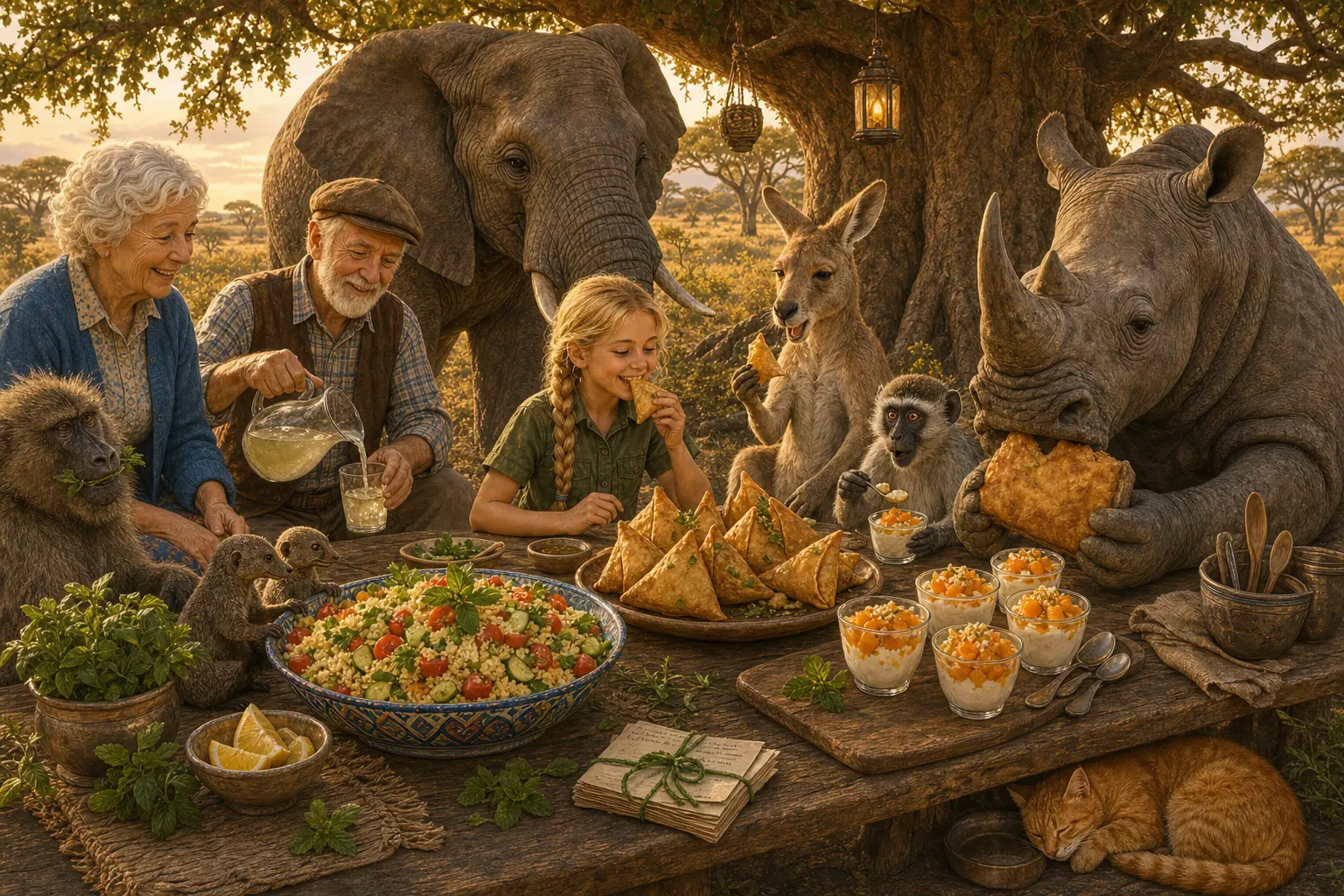
The samosas sat in a warm golden pile. The couscous salad filled a brightly painted bowl. The mango yoghurt cups gleamed in the sunlight.
Omi placed three small cards beside the dishes:
Crisp and Spicy
Fresh and Herby
Sweet and Cool
Everyone sat around the table.
“Remember,” Omi said, “you don’t have to like everything. But you should taste things before deciding.”
Ubejane frowned. “That sounds suspiciously reasonable.”
They began with the samosas.
Lou-Anne bit through the crisp pastry into the soft vegetable filling. “These are delicious.”
Kiera nodded enthusiastically. “Crunchy outside and warm inside.”
M’Pofo ate his in two bites, then looked longingly at the tray.
Vakawu took a bite and widened his eyes. “There may not be bananas, but I am willing to forgive this.”
Ubejane tried his enormous square samosa. It was so thick that the middle had remained slightly soft.
He chewed thoughtfully.
“Dependable,” he declared.
Next came the couscous.
Kiera loved the cucumber and herbs. M’Pofo liked the lemon dressing. Nuru and Buhala carefully picked out the tomatoes first, ate them, and then requested more tomatoes.
Vakawu tasted one spoonful and tilted his head.
“I don’t dislike it,” he said.
“That is practically a speech of devotion from you,” said Lou-Anne.
Ubejane frowned at his bowl for a long moment before taking another bite.
“This would be good beside roasted vegetables,” he admitted.
Omi smiled. “That means you like it.”
“I said no such thing.”
“You took a third spoonful.”
Ubejane quietly continued eating.
Finally, they tried the mango yoghurt.
The cool, sweet fruit was perfect after the warm samosas and bright lemony salad.
Kiera’s ears stood up. “This is my favourite.”
M’Pofo tasted his and gave a deep rumble of happiness.
Vakawu ate the mango first, then the yoghurt, then attempted to lick the bottom of the cup with such dedication that he nearly got it stuck on his nose.
Marmalade ate his chicken and then fell asleep beneath the table, having completed his contribution to international cuisine.
Lou-Anne looked around at her friends and smiled.
“Well?” Omi asked. “What did we learn?”
“That samosas are excellent,” said M’Pofo.
“That mango belongs in everything,” said Kiera.
“That measuring spices is a system designed to suppress artistic freedom,” said Vakawu.
“That square samosas are possible,” said Ubejane.
Omi turned to Lou-Anne.
Lou-Anne thought for a moment. “I think trying new food is a little like going on an adventure. You don’t know whether you’ll love it, but you have to take the first step.”
“Or the first bite,” Omi said.
As evening settled over the Savannah, they packed the leftovers into little containers to share with Opi and the animals who had not been able to come.
Lou-Anne wrote the recipes into her notebook and drew pictures beside them. A triangle for the samosas. A bowl of colourful couscous. A bright orange mango cup.
At the bottom of the page, she wrote:
New does not mean strange forever. Sometimes it simply means not discovered yet.
M’Pofo read the sentence over her shoulder.
“That is a good lesson.”
Vakawu pointed at the samosa tray. “There is also one undiscovered samosa remaining.”
Before anyone could stop him, he grabbed it and raced into the tree.
Ubejane sighed.
Omi laughed.
And Lou-Anne decided that their Great Savannah Tasting Table had been a tremendous success.
They had made new foods, discovered new favourites and created an impressive amount of washing up.
Which, as Omi reminded them, was also part of cooking, despite humanity’s repeated attempts to pretend otherwise.