
Story 39
Lou-Anne and the Mystery at the Village
10 minute read · Mystery and problem-solving
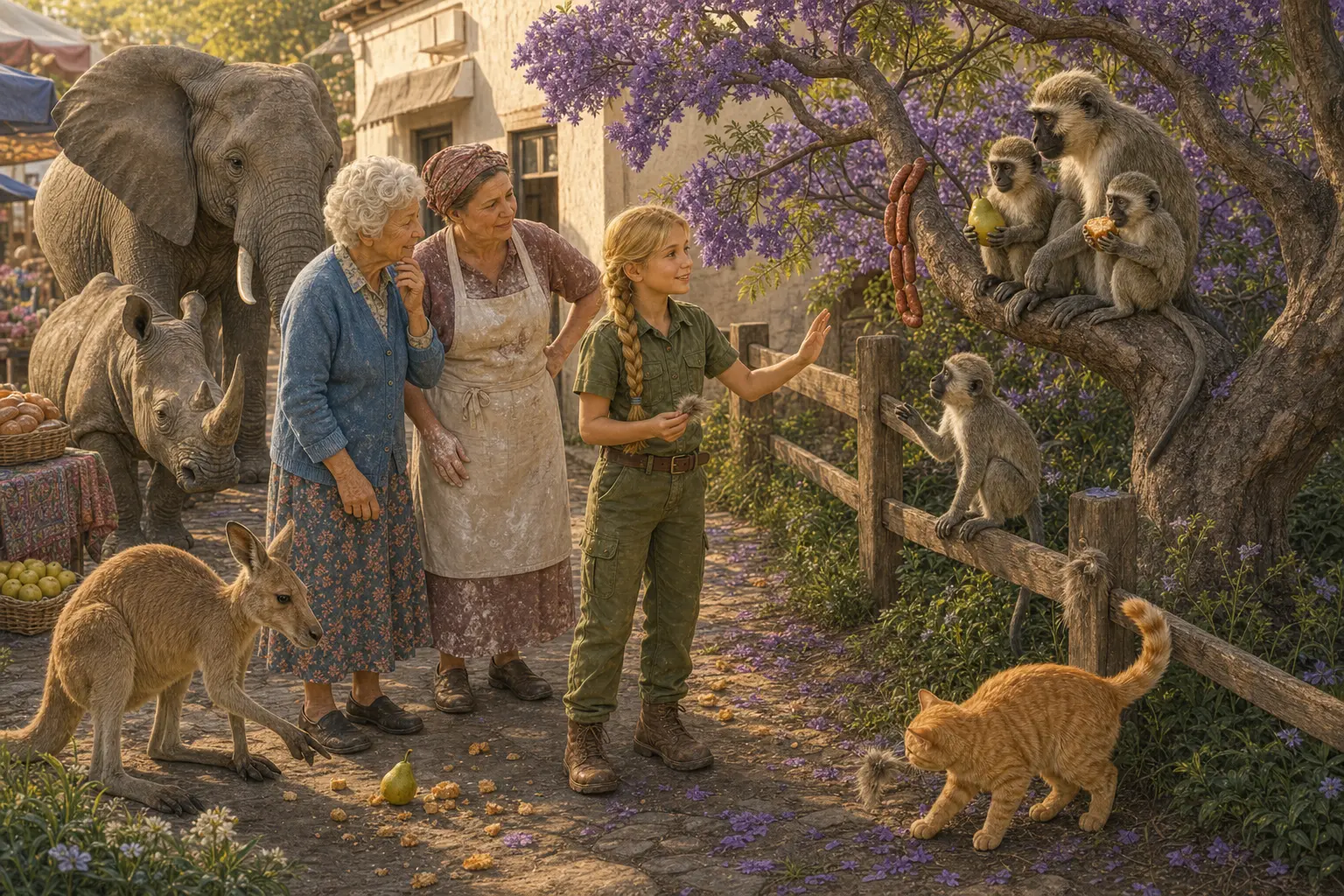
One bright morning, Lou-Anne walked to the village with Omi, Opi, Marmalade, M’Pofo, Kiera, Vakawu, and Ubejane. It was market day, and the village square was full of cheerful noise.
Stalls were covered with colourful cloths. Baskets overflowed with fruit. Fresh bread cooled on wooden boards. Children ran between the tables, and somewhere nearby, a bell rang softly above a little shop door.
Lou-Anne loved market day.
But as soon as they reached the square, something felt wrong.
People were gathered in a little cluster near the fountain, talking all at once.
“What happened?” Lou-Anne asked.
Mrs Belleri, the baker, looked up with her floury hands in the air. “My honey cakes are gone!”
“Gone?” said Lou-Anne.
“Vanished,” said Mr Toma the fruit seller. “And not just that. Three pears from my best basket disappeared, and so did a string of sausages from the butcher’s window.”
Vakawu’s eyes widened. “A thief!”
Omi frowned. “Has anyone seen anything?”
The villagers all shook their heads.
“I turned around for one moment,” said the baker, “and the tray was empty.”
“The same with me,” said the fruit seller. “One moment pears, next moment no pears.”
Marmalade sat down and narrowed his eyes in a very serious cat way.
“A mystery,” said Lou-Anne.
Ubejane snorted. “Or a very hungry criminal.”
Lou-Anne looked around the square.
“Let’s start with clues,” she said.
Vakawu leapt onto the fountain. “At last. My detective skills are needed.”
“No touching things,” said Omi.
Vakawu climbed back down.
Lou-Anne knelt beside the baker’s stall. On the ground below the empty tray were a few crumbs, one sticky spot of honey, and something else.
“A footprint,” she said.
Everyone leaned closer.
It was not a human shoeprint.
Not a hoofprint.
Not even a cat paw.
It was small, with long little toes.
“Kiera?” Lou-Anne said.
Kiera bent down. “Not mine.”
M’Pofo studied it carefully. “Monkey?”
Vakawu looked deeply offended. “I would never steal sausages and pears in the same morning. That would be chaotic.”
“That,” said Ubejane, “is not a denial of theft. Only poor menu planning.”
Lou-Anne followed the crumbs away from the stall. They led across the square, past the flower buckets, under a bench, and around the corner of the post office.
“Come on,” she whispered.
Everyone followed as quietly as they could, which was easier for some than others. M’Pofo tried his best. Ubejane sounded like a cupboard being pushed over gravel.
Behind the post office they found more clues.
A pear stalk.
A crumb of honey cake.
And caught on a nail in the fence, a bit of grey-brown fur.
Lou-Anne carefully lifted it free.
“That’s not monkey fur,” said Vakawu, now extremely interested because it proved he might not be the suspect.
“Not cat either,” said Marmalade, after one thoughtful sniff.
Then from up in the jacaranda tree overhead came a sound.
Rustle. Scramble. Chitter.
Everyone looked up.
There, half hidden among the branches, sat not one thief but three.
A mother vervet monkey and two young ones.
They were surrounded by the missing goods.
One youngster clutched a pear. The other had both hands full of honey cake. The mother sat protectively beside them, looking nervous rather than naughty.
Vakawu gasped. “I know them. They’re new. They came from the far side of the river after the dry weeks.”
Lou-Anne looked more closely. The young monkeys were thin, and the mother’s face looked tired.
“They’re hungry,” she said softly.
Mrs Belleri, who had followed behind with Omi, folded her arms. “Hungry or not, they’ve stolen half my morning baking.”
Omi nodded. “That’s true. But let’s understand before we scold.”
Lou-Anne stepped slowly to the foot of the tree.
“Hello,” she said gently. “You gave everyone quite a fright.”
The mother monkey chirped nervously and pulled the youngsters closer.
Vakawu climbed halfway up the trunk and spoke softly in monkey chatter. The mother answered quickly, her voice sharp with worry and embarrassment.
Vakawu climbed back down.
“She says they didn’t mean to cause trouble. The little ones were hungry. She thought if she waited until people looked away, nobody would notice a few things missing.”
“A few things?” muttered the butcher in the distance. “She took an entire sausage string.”
Vakawu winced. “Yes. Her sense of scale may need work.”
Lou-Anne thought for a moment.
“They still can’t steal,” she said. “But maybe we can help them another way.”
M’Pofo nodded. “A better answer than punishment.”
Ubejane grunted. “And one that involves fewer arguments.”
Omi stepped forward. “If they are staying near the village, we need a plan. Food scraps can be collected properly. Fruit that is too bruised to sell can be left in one place. But no sneaking and no stealing.”
Vakawu translated.
The mother monkey listened, then gave a slow, ashamed nod.
One of the little monkeys held out the last honey cake as if offering it back.
Mrs Belleri’s expression softened at once. “Oh, for heaven’s sake. Keep that one.”
Soon the whole mystery was solved.
The villagers helped set up a feeding spot near the edge of the trees, far from the market stalls. Mr Toma contributed bruised pears and soft bananas. The baker offered broken crusts and leftover rolls. Opi built a small wooden sign that said:
Food for Forest Friends
Please Do Not Steal from the Market
Vakawu read it aloud proudly, although he added several extra dramatic words that were not actually written there.
Lou-Anne helped the little monkeys carry the stolen things down from the tree, except for the half-eaten honey cake, which nobody wanted back.
By midday, the square felt cheerful again.
Mrs Belleri baked a fresh tray of honey cakes. Mr Toma restacked his pears. The butcher hung up his replacement sausages much higher this time. And the villagers all agreed that a solved mystery was much better than an unsolved one.
As for the mother monkey, she kept her promise.
From then on, she and her youngsters stayed away from the market tables and used the feeding place instead. The little ones still looked longingly at the honey cakes sometimes, but now they did so honestly.
That evening, as Lou-Anne and her friends walked home, the sky turned peach and gold over the village roofs.
“Well,” said Kiera, “that was exciting.”
Vakawu puffed out his chest. “We solved it brilliantly.”
“We followed crumbs,” said Ubejane.
“Yes,” said Vakawu. “Brilliantly.”
Marmalade walked with his tail high, clearly pleased to have been part of a proper investigation.
Lou-Anne smiled. “It wasn’t really a story about a thief after all.”
Omi nodded. “No. It was a story about hunger, misunderstanding, and finding a kinder answer.”
M’Pofo rumbled gently. “The best mysteries are the ones that end with everyone safer.”
Lou-Anne thought that was exactly right.
And as the first stars appeared over the Savannah, she decided that market day mysteries were among the very best kind of adventures.
Especially when they ended with honey cake.