
Story 25
Lou-Anne and the Promise of the Savannah
7 minute read · Nature and conservation
The morning began strangely quiet.
Lou-Anne noticed it first as she walked through the tall grass with Marmalade at her heels. Usually the Savannah buzzed with life. Birds sang from the acacia trees, insects hummed in the warm air, and somewhere in the distance M’Pofo could always be heard splashing or trumpeting.
But today, something felt wrong.
The grass near the riverbank had been flattened. A patch of wildflowers had been trampled. And at the edge of the water, Lou-Anne found an empty tin, a torn plastic bag, and old tyre tracks pressed deep into the mud.
She frowned.
“This doesn’t belong here,” she said softly.
Marmalade sniffed the plastic bag and immediately stepped back in disgust.
By the time they reached the baobab tree, the others were already there. M’Pofo looked serious. Ubejane had mud on his feet and a thunderous expression. Vakawu was pacing in the branches above.
“The river is dirtier,” said M’Pofo. “I found bottles in the reeds.”
“And someone broke young branches from my favourite shade tree,” grumbled Ubejane.
Kiera’s ears drooped. “The butterflies aren’t visiting the flower patch anymore.”
Lou-Anne sat down on a rock and looked around at all of them. “Then we have to do something.”
That afternoon, Omi came to visit and listened carefully as Lou-Anne explained everything.
Omi nodded slowly. “This is called conservation,” she said. “It means caring for the natural world so it stays healthy and alive, not only for us, but for everyone who lives here now and everyone who comes after.”
Lou-Anne repeated the word quietly. “Conservation.”
“It’s not just about loving nature,” Omi said. “It’s about protecting it. Cleaning it. Respecting it. Making wise choices.”
Vakawu tilted his head. “So… less talking and more doing?”
Omi smiled. “Exactly.”
The very next morning, the friends began.
Lou-Anne made signs from old wooden boards. She painted them carefully in bright colours:
Keep Our River Clean
Take Your Rubbish Home
The Savannah Is Alive
Protect Trees, Flowers, Water, and Wildlife
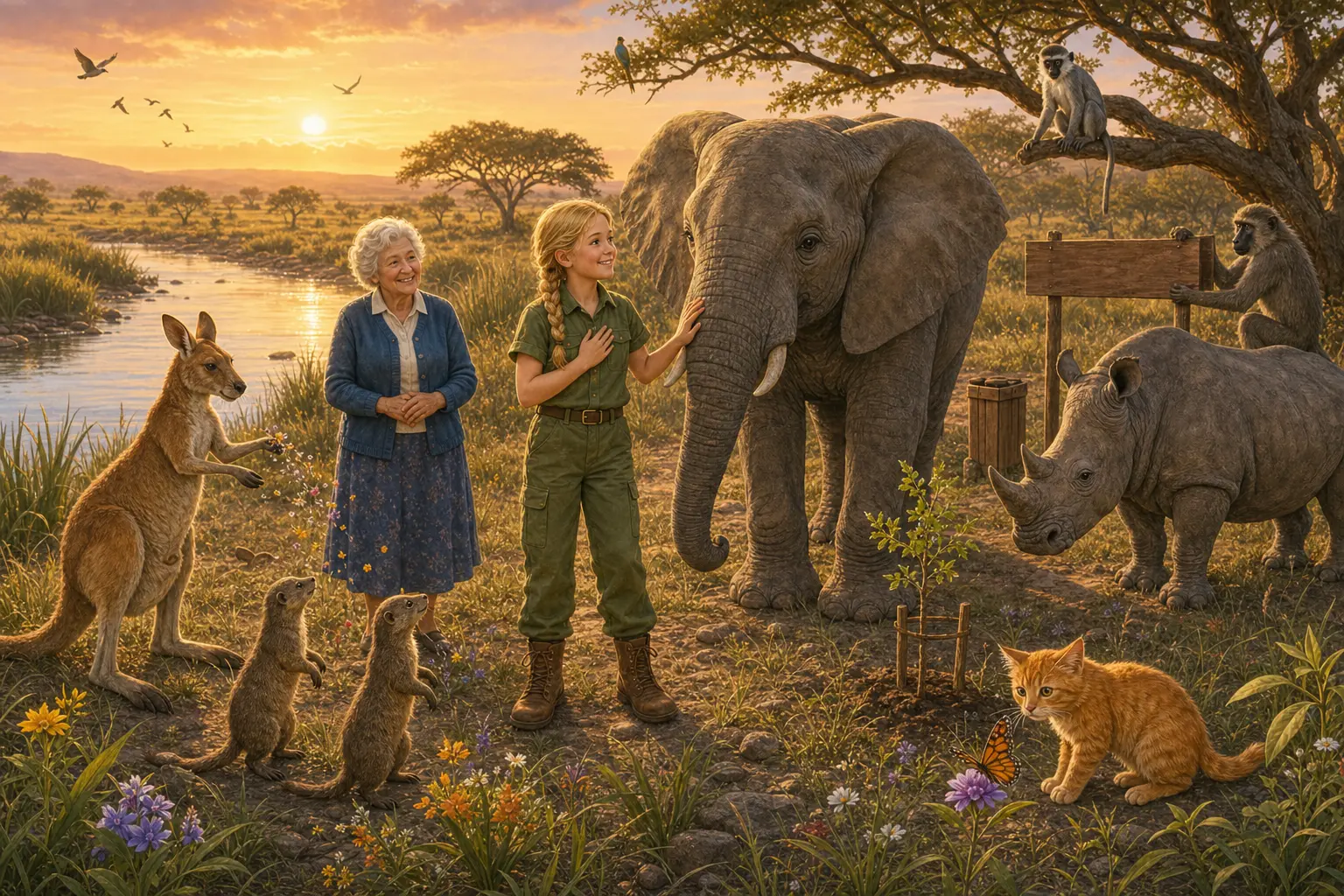
M’Pofo helped carry heavy rubbish away from the riverbank with his trunk. Ubejane pushed aside broken branches and cleared paths where people had driven too close to the grass. Kiera and Dassie gathered bits of litter that had blown into the bushes. Nuru and Buhala found scraps hidden in places no one else could reach.
Vakawu and Batenga climbed trees and tied the signs high enough for visitors to see them.
Marmalade supervised from a shady rock, which he considered a highly important conservation task.
By evening, the riverbank already looked better. The water sparkled again. The flower patch breathed in the breeze. A pair of birds returned to a nearby branch and began to sing.
Lou-Anne smiled. “It’s working.”
But Omi reminded them that conservation was not only about cleaning up after damage.
“It also means preventing harm before it starts,” she said.
So the friends did more.
Lou-Anne spoke to people in the nearby village about using less plastic and never throwing rubbish into nature. Opi helped build a proper rubbish bin near the path. Omi planted herbs and flowers that would attract bees and butterflies.
M’Pofo carried water to thirsty young trees during dry days. Kiera scattered seeds in places where flowers had been lost. Ubejane guarded newly planted saplings with such determination that nobody dared go near them carelessly.
Soon, other animals joined in too. Birds nested higher in protected branches. Meerkats kept watch near the paths. Even the zebras agreed to guide visitors away from sensitive areas.
Little by little, the Savannah began to feel stronger.
One evening, as the sun turned the sky orange and gold, Lou-Anne stood near the river and looked at the land around her. It was not perfect. There would always be more work to do. More people to teach. More places to protect.
But now she understood something important.
Conservation was not one big heroic moment.
It was many small acts of care.
Picking up one piece of rubbish.
Saving one young tree.
Protecting one riverbank.
Teaching one person to do better.
M’Pofo came to stand beside her. “The Savannah looks happy again.”
Lou-Anne nodded. “Because we listened when it needed help.”
Omi smiled from behind them. “That is the heart of conservation. To notice. To care. And to act.”
Marmalade sat down in the grass, gave one approving meow, and watched a butterfly settle on a flower that had only bloomed that morning.
Lou-Anne laughed softly. “That’s our promise then.”
“What promise?” asked Kiera.
Lou-Anne looked out across the golden land, full of life, movement, and song.
“To protect this place,” she said. “Not just because it is beautiful. But because it is home.”
And one by one, under the great open sky, her friends agreed.