
Story 50
Lou-Anne and the Report Worth Celebrating
18 minute read · Learning and confidence
Lou-Anne walked home from school more slowly than usual.
Her school bag rested against her back, and one hand was tucked tightly into the pocket of her green jacket. Inside the pocket was a folded sheet of paper.
Her report card.
She had already read it three times.
The first time, she had read it quickly beside her desk while chairs scraped and everyone hurried to leave.
The second time, she had read it outside the school gate, checking each line more carefully.
The third time, she had stood beneath a chestnut tree and read the comments at the bottom again.
Lou-Anne had worked hard that term. She had practised her maths even when the fractions behaved as though they had been invented specifically to annoy children. She had read aloud until difficult words stopped feeling quite so difficult. She had finished projects, asked questions and tried to listen properly when somebody else was speaking.
Still, carrying the report home felt different from working towards it.
Now Omi, Opi and all her friends would see it.
“What if they think it should be better?” she murmured.
Marmalade, who had met her halfway along the path, looked up at her and meowed.
Lou-Anne sighed. “You don’t even know what a report card is.”
Marmalade rubbed against her boots.
“That is not an answer.”
He did it again.
It was, admittedly, quite a good answer.
When Lou-Anne reached the baobab tree, M’Pofo was using his trunk to arrange fresh leaves in a shady sleeping place. Kiera was practising careful little jumps between painted stones. Vakawu, the vervet monkey, was hanging by his tail from a branch while attempting to eat a fig upside down.
Ubejane stood nearby, looking as if the entire afternoon had disappointed him personally.
“You’re late,” Vakawu called.
“I came straight from school.”
“Then school is late.”
“That is not how time works,” said Ubejane.
Lou-Anne sat on a smooth root beneath the tree. Marmalade jumped up beside her and placed one paw on her school bag.
M’Pofo noticed her expression. “Did something happen?”
Lou-Anne hesitated.
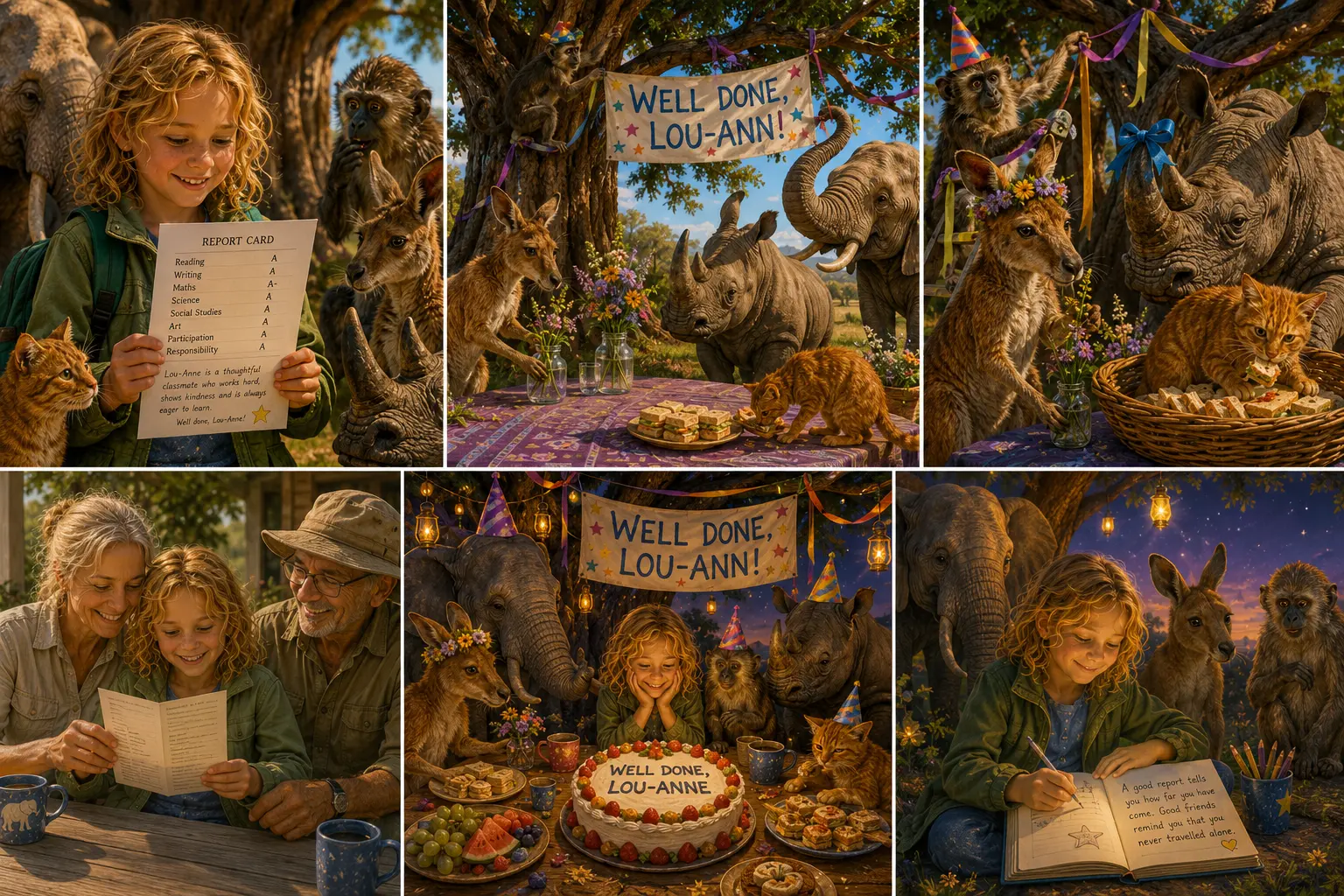
Then she reached into her pocket and pulled out the folded paper.
“We got our report cards today.”
Kiera bounced closer. “Is it good?”
“I think so.”
Vakawu dropped from the branch and landed beside her. “What does it report?”
“My work at school. Reading, writing, maths, science, how I participate and how I behave.”
Vakawu frowned. “Someone has written a whole document about how you behave?”
“Yes.”
“That seems dangerous.”
Ubejane peered at him. “For you, certainly.”
Lou-Anne unfolded the report card but kept it turned towards herself.
M’Pofo sat beside her. “Would you like us to read it?”
“I’m not sure.”
“That’s all right,” he said. “You can show us when you’re ready.”
Lou-Anne looked down at the page again.
The marks were strong. More importantly, her teacher had written that she was curious, dependable and kind to others. She contributed thoughtful ideas, worked well with classmates and had made particularly good progress in maths.
That last part mattered to Lou-Anne. Maths had not always come easily. There had been evenings when she wanted to close the book and never look at another fraction again.
Instead, she had kept trying.
She took a breath and held out the page.
M’Pofo read it first, moving the paper carefully with the tip of his trunk.
His face brightened.
“Lou-Anne,” he said, “this is wonderful.”
Kiera leaned over. “What does it say?”
“It says she has done very well,” M’Pofo replied. “And that she is curious, responsible and considerate.”
Vakawu took the report and held it upside down.
“I agree entirely.”
“You cannot read it like that,” said Ubejane.
“I am appreciating the structure.”
Ubejane took the paper away and read it properly.
His expression stayed stern for several seconds.
Then he gave one approving nod.
“Good work.”
Lou-Anne smiled. Praise from Ubejane rarely arrived dressed in ribbons, but it was always genuine.
“You really think it’s good?” she asked.
M’Pofo looked surprised. “Of course it is.”
“But not everything is perfect.”
Omi’s voice came from behind them.
“Nothing worth learning ever is.”
She was walking towards the baobab with Opi, both carrying baskets. Lou-Anne quickly folded the report card, though by then the secret had clearly escaped into the wild.
Omi sat beside her. “May I see?”
Lou-Anne handed it over.
Omi read every line slowly. Opi looked over her shoulder, adjusting his glasses.
When they finished, Omi’s eyes were shining.
“I’m very proud of you.”
“So am I,” said Opi.
Lou-Anne felt warmth spread through her chest.
“Because of the marks?”
“The marks are lovely,” Omi said. “But I’m proud because they show what you put into them. You practised. You asked for help. You kept going when something was difficult.”
Opi tapped the teacher’s comment gently. “And this part may be the best of all.”
Lou-Anne followed his finger.
Lou-Anne is a thoughtful classmate who notices when others need help.
“Being clever is useful,” Opi said. “Being kind with what you know is even better.”
Marmalade placed both front paws on Lou-Anne’s leg and stared at the report card.
“You may inspect it,” Lou-Anne told him, “but you are not allowed to sit on it.”
Marmalade sat on it.
Human achievement had once again been placed beneath a cat.
Lou-Anne eventually rescued the paper and tucked it safely into her bag.
Omi and Opi exchanged a glance.
Then Omi stood.
“We’ll see you at supper.”
“You’re leaving already?” asked Lou-Anne.
“Only briefly. We have a few things to do.”
Vakawu suddenly became extremely interested in a cloud.
Kiera stared at the ground.
M’Pofo began rearranging the same three leaves he had already arranged.
Lou-Anne narrowed her eyes. “Why is everyone acting strange?”
“We are not,” said Ubejane, far too quickly.
“You definitely are.”
Vakawu pointed into the distance. “Perhaps you should go home and place your report card somewhere safe.”
“Why?”
“Because paper is vulnerable to weather, goats and administrative confusion.”
Lou-Anne stared at him.
Vakawu was a terrible liar. He was somehow even worse when trying to sound intelligent.
Still, she let Omi lead her back towards the house.
Behind them, the baobab clearing erupted into activity.
M’Pofo carried a long table beneath the tree.
Kiera fetched wildflowers and placed them in little jars.
Ubejane pushed two benches into position, grumbling that nobody else knew how to align furniture properly.
Vakawu climbed through the branches, hanging ribbons and a homemade banner. The banner read:
WELL DONE, LOU-ANNE!
At least, that was what it was meant to say.
Vakawu had accidentally written:
WELL DON, LOU-ANN!
Ubejane stared at it.
“You have lost two letters.”
“I have improved efficiency.”
“You are going back up there.”
Meanwhile, Marmalade had been given the important task of guarding a basket containing small cheese sandwiches.
This was a managerial decision of extraordinary optimism.
When Kiera returned, Marmalade was sitting beside the basket with perfect innocence.
One sandwich was missing.
“Marmalade.”
He washed one paw.
“There were twelve.”
Marmalade washed the other paw.
Kiera counted again.
There were eleven sandwiches and one very satisfied orange cat.
At Omi and Opi’s house, Lou-Anne placed her report card on the kitchen table.
Omi made cocoa while Lou-Anne told her about the school term.
“The science project was my favourite,” Lou-Anne said. “We grew seeds under different conditions to see what they needed.”
“And what did you discover?”
“That plants need enough light and water, but too much water can be a problem too.”
“Most things need balance,” said Omi.
“Even people?”
“Especially people.”
Lou-Anne wrapped both hands around her mug.
“I was worried about showing you the report.”
Omi sat across from her. “Why?”
“I don’t know. Maybe because everyone would know how I’d done.”
Omi nodded. “Reports can feel very large when they’re folded in your pocket.”
Lou-Anne smiled. “It did feel large.”
“A report card tells you something about one part of one school term,” Omi said. “It does not measure everything about you. It cannot measure how well you comfort a friend, how carefully you notice animals or how many times you try again after making a mistake.”
“So a good report is worth celebrating, but it isn’t everything?”
“Exactly.”
Lou-Anne thought about that as she finished her cocoa.
A good report card felt lovely.
But she liked knowing she was more than a collection of marks on paper.
Just before sunset, Opi appeared at the kitchen door.
“We need Lou-Anne at the baobab.”
“What for?” she asked.
“An urgent matter involving cake.”
That seemed worth investigating.
When Lou-Anne reached the clearing, everyone was waiting beneath the decorated branches.
“Surprise!” they shouted.
The banner now contained all its required letters. Humanity had survived another spelling emergency.
The table was filled with fruit, small sandwiches, vegetable pastries and a round cake decorated with strawberries. In the centre, Omi had piped the words:
WELL DONE, LOU-ANNE
M’Pofo wore a paper party hat between his ears. Kiera had a flower crown. Ubejane wore no decoration at all, but someone had tied a blue ribbon around his horn while he was not looking.
Vakawu wore three party hats stacked on top of one another.
Marmalade sat beside the food basket, pretending he had never encountered a sandwich in his life.
Lou-Anne stopped and covered her mouth.
“You did all this for me?”
M’Pofo lifted his trunk. “You worked hard.”
Kiera clapped her paws. “And you got a wonderful report!”
“And,” said Ubejane, “you are generally tolerable company.”
Lou-Anne laughed. “Thank you, Ubejane.”
“You’re welcome.”
Omi gave Lou-Anne a hug. “This party is not because we expect perfection. It is because effort deserves to be noticed.”
Opi handed her a little wrapped parcel.
Inside was a new set of coloured pencils and a notebook with her name embossed on the cover.
On the first page, everyone had added something.
M’Pofo had made a small trunk print.
Kiera had drawn a flower.
Vakawu had written:
FOR IMPORTANT IDEAS AND POSSIBLY MONKEY STORIES
Ubejane had written only:
KEEP GOING.
And Marmalade had left one orange paw print across the bottom of the page.
Lou-Anne held the notebook against her chest.
“I love it.”
The celebration began with cake.
M’Pofo received an elephant-sized slice. Kiera carefully selected one with two strawberries. Vakawu claimed the top layer contained more educational value because it had extra icing.
Ubejane ate his slice quietly, then returned for another under the pretence of checking whether the pieces were evenly cut.
Marmalade received a tiny portion of plain chicken, because cake and cats remain a poor partnership no matter how persuasively the cat argues.
After they ate, everyone took turns saying something they admired about Lou-Anne.
Kiera admired that she helped others without making them feel foolish.
M’Pofo admired her curiosity.
Opi admired her patience.
Omi admired her courage when something was difficult.
Vakawu admired her willingness to listen to his ideas, “including the excellent ones, the ambitious ones and the ones everybody else wrongly calls nonsense.”
Ubejane thought for a moment.
“You do not give up easily,” he said. “That will matter more than any single mark.”
Lou-Anne’s eyes stung a little.
“Thank you,” she said softly.
Then she looked around at all of them.
“I couldn’t have done it alone. Omi helped me practise. Opi explained fractions. M’Pofo listened when I read aloud. Kiera tested my spelling words. Even Vakawu helped with science.”
Vakawu puffed out his chest.
“You dropped three different fruits from a tree so I could measure how fast they fell,” Lou-Anne continued.
“Groundbreaking research.”
“One of them landed on Ubejane.”
“A minor experimental complication.”
Ubejane’s expression suggested the research remained under review.
As evening settled, they lit little lanterns beneath the baobab. The party softened into stories, laughter and the quiet warmth of being together.
Lou-Anne sat beside Omi with her new notebook in her lap. Marmalade curled against her side, exhausted by the considerable burden of having nearly guarded the sandwiches.
“I thought the best part would be seeing the good marks,” Lou-Anne said.
“And was it?” Omi asked.
Lou-Anne looked at the banner, the empty cake plates and her friends gathered beneath the lanterns.
“No. I think the best part was knowing everyone noticed how hard I tried.”
Omi kissed the top of her head.
“That is always worth celebrating.”
Lou-Anne opened her notebook and wrote one sentence on the first clean page:
A good report tells you how far you have come. Good friends remind you that you never travelled alone.
M’Pofo read it over her shoulder and gave a gentle rumble.
“That is very good.”
Vakawu leaned in from the other side.
“I would add something about cake.”
Lou-Anne laughed and closed the notebook before he could improve it.
Above them, the stars appeared one by one over the Savannah.
The school term was finished. The report card was safely tucked away. And Lou-Anne’s heart felt full, not because she had been perfect, but because she had worked, learned, grown and been loved through all of it.
Which was a far better result than any number printed on a page.