
Story 62
Lou-Anne and the Savannah Bake Sale
17 minute read · Wildlife conservation, community and teamwork
The first sign of trouble appeared beside the old waterhole.
Lou-Anne was walking there with M’Pofo when she noticed a wooden post leaning sideways in the mud. A little sign hung from it by one corner.
Wildlife Conservation Area
The words were faded, and one edge of the sign had been nibbled by something with very determined teeth.
Nearby, two conservation rangers were examining a broken water pump. Without the pump, the shallow drinking pool would dry up before the next rains arrived.
“What happened?” Lou-Anne asked.
Ranger Thandi wiped the dust from her hands.
“The pump is old, and several pipes need replacing,” she explained. “We also need new signs to remind visitors not to leave the paths or drop rubbish. Unfortunately, the conservation fund is nearly empty.”
M’Pofo looked at the shrinking pool. Birds, antelope and smaller animals all depended upon it during the dry weeks.
“We must help,” he said.
Lou-Anne agreed at once, although she was less certain about how.
She did not have enough money to repair a water pump. Neither did M’Pofo, who had never owned a wallet and considered this one of his better qualities.
“We could collect rubbish,” Lou-Anne suggested.
“That would help,” said Ranger Thandi. “But the repairs will still cost money.”
Lou-Anne thought all the way back to the baobab tree.
Vakawu was hanging from a branch, Marmalade was asleep between two roots, and Kiera was playing a hopping game with Nuru and Buhala. Ubejane stood in the shade, looking as though nothing interesting had happened for several years.
Lou-Anne told them about the broken pump.
“We need a way to raise money,” she finished.
Vakawu raised one hand.
“We could charge visitors to watch me perform astonishing acrobatics.”
“No,” said Ubejane.
“You have not even seen the performance.”
“I have seen enough of your performances.”
Kiera tilted her head. “What could we make that people would want to buy?”
At that moment, Omi arrived carrying a basket covered with a checked cloth. The warm smell drifting from it made every head turn.
“I’ve brought banana bread,” she announced.
Vakawu dropped from the branch.
Lou-Anne stared at the basket and then at Omi.
“That’s it!”
Vakawu had already reached the basket. “I agree. Banana bread is always the answer.”
“No,” Lou-Anne said, gently moving his hand away. “We can hold a bake sale!”
A plan full of crumbs
The friends gathered around Omi while Lou-Anne explained.
They would bake cakes, biscuits, bread and savoury treats. Then they would sell everything at the village market and give the money to the wildlife conservation team.
Omi liked the idea.
“A bake sale can raise money,” she said, “but only if we plan carefully. Ingredients cost money too, and food must be prepared safely.”
Opi brought a notebook and helped them make a list.
Omi would donate flour, sugar and butter. The village shopkeeper offered eggs and cooking chocolate. Ranger Thandi promised to bring a display explaining how the repaired pump would help local wildlife.
Everyone chose a job.
Lou-Anne and Omi would manage the recipes and ovens.
Kiera would measure ingredients and carry supplies in her pouch.
Nuru and Buhala would count paper cake cases.
M’Pofo would mix the largest bowls with a wooden spoon held carefully in his trunk.
Ubejane would move the heavy tables into place.
Marmalade would stay out of the kitchen.
Marmalade objected to this arrangement, mostly by sitting directly in the kitchen doorway.
Vakawu volunteered to decorate the cakes.
Omi considered this.
“You may decorate them,” she decided, “but you may not invent the measurements.”
Vakawu placed a hand over his heart. “I would never interfere with important scientific quantities.”
Ubejane snorted. “Last time, your ‘small spoonful’ of cinnamon required its own hill.”
The great baking morning
On Saturday, everyone met at Omi and Opi’s house before sunrise.
The kitchen soon filled with the sounds of whisking, stirring and bowls being moved from one crowded surface to another.
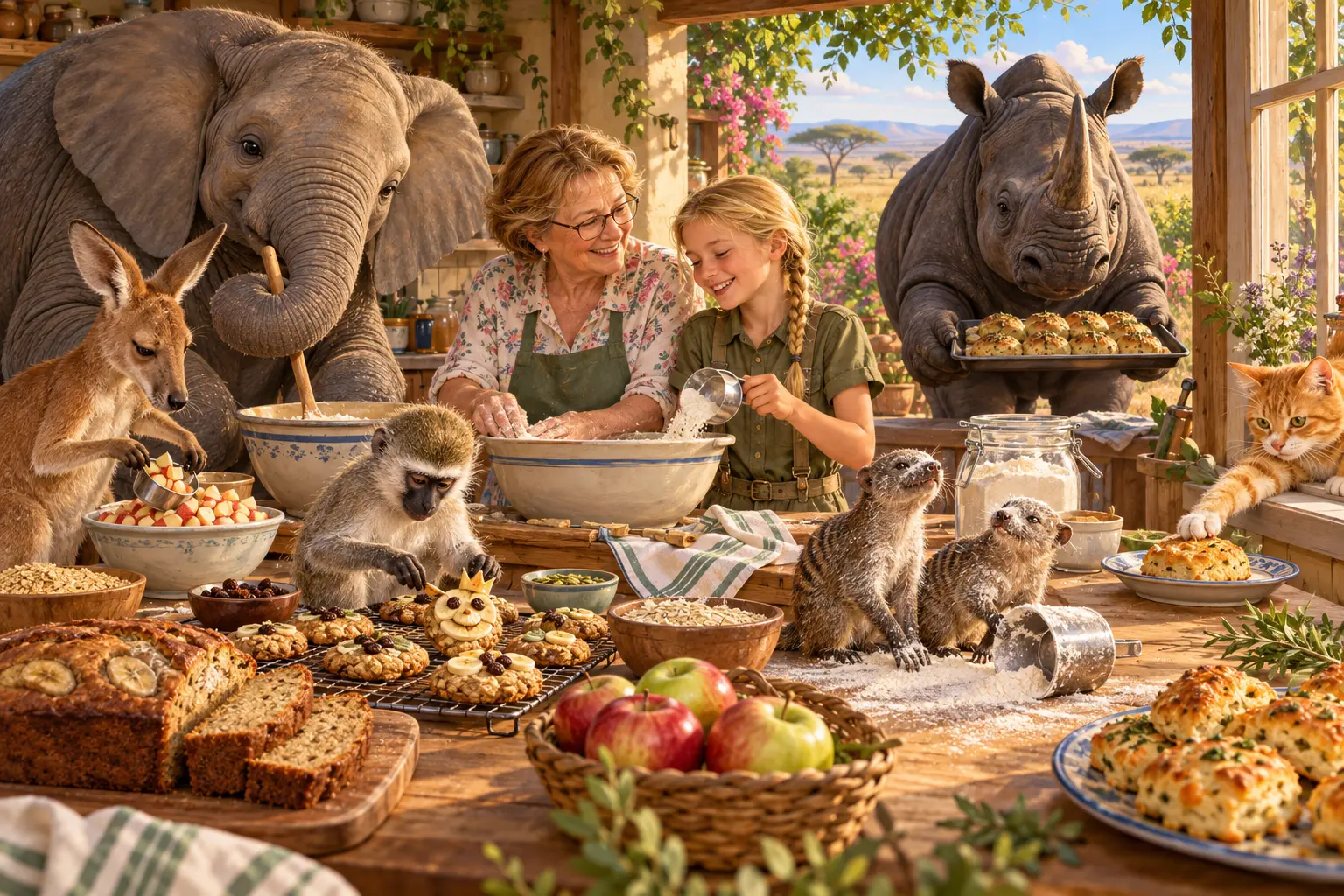
Lou-Anne and Omi began with apple muffins. Lou-Anne measured the flour while Kiera added chopped apple.
“Two cups,” Lou-Anne said.
Kiera carefully tipped in the first cup. Then Nuru and Buhala carried the second between them, moving so slowly that the flour remained almost level.
They reached the bowl without spilling anything.
“We did it!” Nuru cheered.
Buhala’s tail knocked the cup over.
A cloud of flour rose into the air and settled over both mongooses.
They stared at one another.
“You look old,” said Nuru.
“So do you,” said Buhala.
At the other end of the kitchen, M’Pofo mixed dough for savoury herb rolls. He turned the spoon slowly and steadily.
“Not too fast,” Omi reminded him.
“I remember,” he said.
Vakawu was decorating oat biscuits with little patterns made from dried fruit. Some looked like elephants. Some looked like flowers. One appeared to be a banana wearing a crown.
“What is that one?” Lou-Anne asked.
“A portrait of me as king of the bake sale.”
“Why are you a banana?”
“Art should make people think.”
Ubejane carried trays from the kitchen to the cooling table outside. He complained about every journey, yet arranged each tray with perfect care.
Marmalade remained in the garden beneath strict supervision. Opi had given him a small dish of chicken to distract him from the butter.
It worked for almost four minutes.
Then Lou-Anne noticed an orange paw reaching through the open kitchen window towards a cooling cheese scone.
“Marmalade!”
The paw disappeared.
Marmalade appeared moments later from behind a flowerpot, wearing the innocent expression of a cat who had never heard of either cheese or windows.
By mid-morning, they had filled the tables with apple muffins, banana bread, chocolate brownies, oat biscuits and savoury herb rolls.
Omi had also prepared small cards listing the ingredients, so visitors with allergies could choose safely.
Lou-Anne looked proudly at everything they had made.
Then the sun came out.
It grew warmer and warmer.
The chocolate topping on the brownies began to shine.
One of Vakawu’s carefully decorated biscuits lost a raisin eye.
And the icing on the little lemon cakes started sliding sideways.
“Our cakes are melting!” Kiera cried.
A cool solution
Everyone rushed to save the food.
Ubejane moved the tables deeper into the shade. M’Pofo soaked a large cloth in cool water and hung it where the breeze could pass through it. Kiera fetched covered baskets from the house, while Nuru and Buhala carried the smallest cakes into the coolest room.
Vakawu stood over the lemon cakes.
“Do not panic,” he told them. “You are still beautiful.”
“They are cakes,” said Ubejane. “They cannot hear you.”
“That is no reason to be discouraging.”
Omi inspected the food. Nothing had spoiled, but they would have to keep the creamy items cool and sell them first.
“Problems happen,” she said. “Good planning means noticing them and changing what you are doing.”
Lou-Anne added bags of ice around the covered cake containers.
Within a few minutes, everything was safe again.
The lemon cakes remained slightly crooked, but Vakawu renamed them “Savannah Slope Cakes” and insisted the angle made them more valuable.
The market opens
The village market was already busy when the friends arrived.
Opi hung a painted sign above their stall.
BAKE SALE FOR THE SAVANNAH WATERHOLE
Ranger Thandi placed photographs beside the cakes. They showed elephants, birds, antelope, tortoises and many smaller creatures drinking at the conservation area.
She also brought a clear jar with a line marked around its middle.
“If we fill the jar to here,” she explained, “we can replace the broken pipes. Anything extra will help pay for new signs and native plants.”
At first, only a few people stopped.
Lou-Anne suddenly felt nervous. What if nobody wanted their cakes? What if they had spent the whole morning baking and raised hardly anything?
Then M’Pofo lifted his trunk.
“Fresh cakes for a fresh waterhole!” he called.
His voice carried across the market.
People turned.
Kiera offered tiny samples of banana bread. Nuru and Buhala handed out leaflets. Ubejane stood beside the money jar like the most dependable guard imaginable.
Vakawu balanced three oat biscuits on his head.
“Buy a biscuit,” he announced, “and help an elephant have a drink!”
M’Pofo looked at him.
“Or a bird,” Vakawu added. “Or a tortoise. Or anyone else who is thirsty.”
Soon, customers gathered around the stall.
A teacher bought twelve apple muffins for her class. A farmer chose herb rolls for his family. Two children pooled their coins to buy the crowned banana biscuit.
An elderly man looked at the crooked lemon cakes.
“Why are those leaning?” he asked.
Vakawu smiled. “They represent the difficulties faced by modern conservation.”
The man bought three.
The coins in the jar rose steadily.
Marmalade sat beside the stall wearing a small green ribbon. He attracted nearly as many visitors as the cakes, although he refused to admit that this was work.
By lunchtime, the brownies were gone.
Then the muffins sold out.
Only one loaf of banana bread and a few herb rolls remained when Batenga appeared.
The baboon inspected the table.
“I hear this is for wildlife conservation.”
“It is,” Lou-Anne said.
Batenga placed several coins in the jar and reached for the banana bread.
“That is very generous,” said M’Pofo.
Batenga grinned. “I have always supported the conservation of bananas.”
More than enough
When the final herb roll had been sold, Ranger Thandi counted the money with Lou-Anne and Omi.
Everyone watched the jar.
First, they had enough for the pipes.
Then enough for the repair work.
There was still money left for three new signs and a row of native shrubs that would provide shade for small animals.
“We did it!” Kiera shouted.
M’Pofo trumpeted so loudly that a flock of birds rose from the nearby trees.
Ubejane smiled. It was not a large smile, but everyone saw it.
Vakawu bowed to the remaining customers.
“Thank you. The cakes were excellent because I supervised them.”
“You dropped a raisin into the washing-up water,” Ubejane reminded him.
“A minor administrative detail.”
Ranger Thandi thanked them all.
“You did more than raise money,” she said. “You helped people understand why the waterhole matters. Conservation works best when a whole community cares.”
Lou-Anne looked at the empty trays, the flour still clinging to Nuru’s whiskers and the spot of icing stuck to Vakawu’s ear.
They had not repaired the waterhole by themselves. They had baked, explained, listened and invited other people to help.
That was how a small idea had become something much larger.
Water for everyone
A week later, the friends returned to the conservation area.
The broken pipes had been replaced. The sign stood straight again, freshly painted and easy to read. Beside the path, new signs reminded visitors to take their rubbish home and give wild animals plenty of space.
Ranger Thandi switched on the repaired pump.
For a moment, it made a deep rattling sound.
Then clear water poured into the drinking pool.
M’Pofo splashed his trunk happily. Birds flew down to the edge, and a family of warthogs waited nearby for their turn.
Nuru and Buhala inspected the young shrubs planted beside the path.
“One day these will make good shade,” said Buhala.
“And good hiding places,” added Nuru.
Ubejane lowered his head to drink.
“Not bad for a table full of cakes,” he admitted.
“Not just cakes,” Lou-Anne said. “There were also herb rolls.”
“Structurally excellent herb rolls,” Ubejane agreed.
They stayed until the afternoon light turned soft and golden.
Back beneath the baobab, Omi shared one small banana loaf she had secretly saved for the helpers. They ate it slowly while the first stars appeared.
Lou-Anne rested against M’Pofo’s warm side.
The bake sale had been noisy and busy. There had been flour in the air, melting icing, a thieving orange paw and several very questionable biscuit designs.
Yet now, far across the quiet Savannah, fresh water was filling the pool.
Tomorrow, animals they might never meet would drink from it.
Trees would grow beside it.
Birds would bathe in it.
And all of it had begun with a faded sign, a worried thought and one basket of Omi’s banana bread.
Lou-Anne smiled sleepily.
Sometimes helping the whole Savannah did not begin with a grand adventure.
Sometimes it began in a warm kitchen, with friends gathered around a mixing bowl, wondering what they could make together.