
Story 41
Lou-Anne and the Day of the Chilbi
11 minute read · Friendship and adventure
One bright Saturday morning, the Savannah felt full of excitement before anyone had even said why. The breeze carried music from far away. Bells jingled. Somewhere beyond the trees came a burst of laughter, and then the faint smell of roasted nuts and sweet dough.
Lou-Anne looked up from tying her shoelaces. “It’s today!”
Marmalade, who was sitting in a patch of sunshine and pretending not to listen, flicked one ear.
Omi came down the path in her good cardigan, with Opi just behind her wearing his hat. “Yes,” Omi said with a smile. “Today is the Chilbi in the village.”
Kiera gave a delighted bounce. “The fair!”
Vakawu nearly fell out of the tree. “With games? And rides? And snacks?”
“And people,” said Ubejane darkly.
“And people,” Opi agreed cheerfully.
M’Pofo lifted his trunk. “I have never been to a Chilbi.”
“Then today,” Lou-Anne said, taking his side gently, “you are going to love it.”
Ubejane snorted. “Too early to make promises like that.”
They all set off together along the village path.
Lou-Anne wore her green jumper and carried a little cloth purse Omi had given her with a few coins inside. Marmalade trotted beside her, though Omi had warned him very clearly that if he caused trouble at the Chilbi, he would not be getting any sausage.
That was enough to ensure at least partial good behaviour.
As they drew nearer, the sounds grew louder. Accordion music mixed with children shouting, stallholders calling, and the creaking whoosh of fairground rides turning in the air.
Then they rounded the last bend, and there it was.
The village square had been transformed.
Strings of little flags fluttered overhead. Colourful stalls lined the street. A carousel turned slowly in one corner with painted horses and tiny bells. There were booths for ring tossing, tin can throwing, lucky fishing, and guessing games. A Ferris wheel rose above the rooftops, turning gently against the blue sky.
The air smelled of fried dough, grilled sausages, caramel, popcorn, and roasted almonds.
M’Pofo stopped dead.
“Oh,” he said.
Lou-Anne smiled. “That’s the correct reaction.”
They began at the food stalls, because of course they did.
Omi bought fresh pretzels sprinkled with salt. Opi came back with paper cones of roasted almonds. Lou-Anne was given a little bag of sugared nuts and a warm slice of apple tart.
Marmalade sat down beside the sausage stand and looked so patient and tragic that even the butcher laughed.
“He’s excellent,” said the butcher. “Terrible manners in a cat would be one thing. But this one knows theatre.”
“He does,” said Lou-Anne.
Marmalade received one tiny piece of sausage and considered the morning an immediate success.
Kiera found a stall with bright red candy apples and stared at them as though they were magical objects. Vakawu was more interested in spun sugar, though half of his ended up on his face, his hands, and one ear.
Ubejane claimed he wanted “nothing sweet,” then ate two warm cheese pastries in complete silence.
“No one saw that,” he said afterward.
“Everyone saw that,” said Omi.
After that came the games.
Lou-Anne tried the ring toss first and nearly won a jar of honey, but her last ring bounced off the neck of the bottle and landed in a hat someone had foolishly left nearby.
Vakawu insisted on the tin can throwing booth because, in his words, “I am built for glory.”
He was not.
His first throw missed the cans completely. His second hit the wooden edge and bounced back at him. His third knocked over exactly one can and himself.
The stallholder gave him a consolation whistle out of pity.
Vakawu declared this a great victory.
Kiera did wonderfully at the lucky fishing game and won a little painted wooden bird on a string. She loved it immediately. M’Pofo used his trunk at the duck pond and managed, very delicately, to hook a floating duck without sinking the whole game, which the man running the booth said was one of the finest displays of trunk control he had ever seen.
Ubejane refused all games until Opi pointed out a strength tester with a large wooden hammer.
“You hit the plate,” said Opi, “and try to ring the bell.”
Ubejane looked at the hammer. Then at the bell. Then at the crowd beginning to gather.
“I suppose,” he said, “for scientific purposes.”
He took the hammer, swung once, and sent the marker smashing right to the top with such force that the bell rang twice and a pigeon flew off a nearby roof in alarm.
The crowd cheered.
Ubejane handed the hammer back and said, “Adequate.”
He was given a prize ribbon and pretended not to care about it for the next three hours.
At midday they went on the rides.
Lou-Anne and Kiera chose the carousel first, and M’Pofo stood nearby watching them go round and round on painted horses while the music played. Vakawu tried to stand on his carousel horse instead of sitting on it and had to be told off by three different adults and one very stern grandmother.
Then came the Ferris wheel.
From below, it looked high.
From the top, it looked very high.
Lou-Anne sat with Omi and Kiera in one little carriage. M’Pofo had his own specially reinforced one, which delighted him so much that he forgot to be nervous entirely. Vakawu pressed his face to the bars and gave a running commentary on every roof, tree, chimney, and cabbage patch in the village.
From the top, they could see everything.
The church tower.
The lake shining in the distance.
The little roads winding between houses.
The colourful Chilbi spread out below like a toy village.
And beyond all that, the wider land stretching away in green and gold.
“It’s beautiful,” Lou-Anne said softly.
Omi smiled. “A village always looks especially lovely from above when it is full of joy.”
Even Marmalade, who had remained on the ground with Opi and was highly suspicious of unnecessary height, admitted later that the Ferris wheel looked acceptable from below.
In the afternoon, the music got livelier.
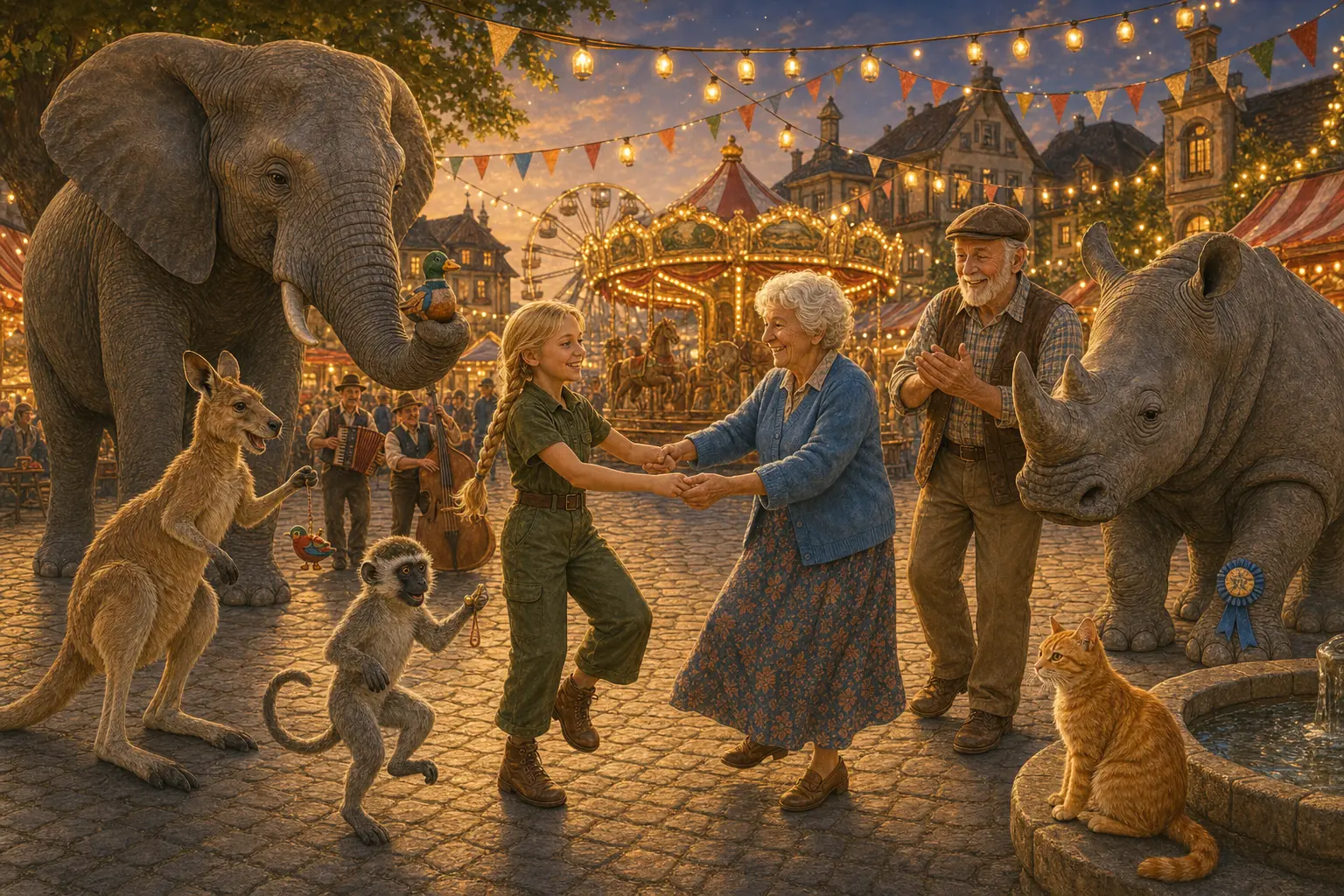
A little folk band began playing near the fountain, and soon the square filled with clapping. Children danced. Grown-ups laughed. Someone began yodelling in the distance with more confidence than talent.
Kiera started bouncing in time to the music.
Vakawu danced beside her in what he claimed was a traditional monkey step, though nobody could verify this.
M’Pofo swayed gently from side to side, ears flapping in rhythm. Lou-Anne laughed and grabbed Omi’s hands, pulling her into a small circle dance on the cobbles.
Even Ubejane’s feet started tapping.
“You’re dancing,” said Opi.
“I am standing rhythmically,” said Ubejane.
“Of course,” said Opi.
As evening came, lanterns were lit around the square. The rides glowed with warm yellow bulbs. The sky turned soft peach, then rose, then deep blue. Someone brought out one final tray of hot mini doughnuts dusted with sugar, and the whole fair felt wrapped in light and music and the happy tiredness of a day well spent.
Lou-Anne sat on the edge of the fountain with Marmalade in her lap and looked around at all her friends.
M’Pofo was holding his duck pond prize very carefully.
Kiera still had her painted bird.
Vakawu had somehow won another whistle and was using both.
Ubejane sat with his prize ribbon tucked under one front foot as if it had happened by accident.
Omi and Opi looked tired and pleased in exactly the right amounts.
“This,” Lou-Anne said, “was one of the best Chilbis ever.”
M’Pofo nodded. “I liked the Ferris wheel.”
“I liked the sugared nuts,” said Kiera.
“I liked the bell-ringing contest,” said Vakawu.
“You did not win that,” said Ubejane.
“No,” said Vakawu. “But I liked watching you pretend not to enjoy it.”
That made Lou-Anne laugh so much she had to hold onto Marmalade for balance.
As they finally walked home beneath the first stars, with music still drifting behind them and the scent of roasted almonds lingering in the air, Lou-Anne felt warm all the way through.
The Chilbi had been noisy and busy and bright.
But most of all, it had been full of the simple magic of sharing a happy day with the people and animals you loved best.
And that, she thought, was worth more than all the ribbons, rides, and doughnuts in the village.
Even though the doughnuts had been excellent.