
Story 42
Lou-Anne and the Night at the Water Hole
13 minute read · Water adventure
One evening, just as the sun was beginning to sink low over the Savannah, Omi arrived beneath the baobab tree carrying a lantern, a rolled-up blanket, and a basket of snacks.
Lou-Anne looked up at once. “Omi, what are we doing?”
Omi smiled. “Tonight, if everyone is careful and quiet, we are going to the water hole after dark.”
Kiera’s ears shot up. “At night?”
Vakawu nearly somersaulted out of the tree. “A night adventure!”
M’Pofo lifted his trunk with interest. “Many animals visit the water hole at night.”
Ubejane grunted. “So do many insects. That part seems less excellent.”
Marmalade, who was washing one paw in the last patch of sunlight, paused and looked deeply suspicious. Night-time was usually for stalking tiny things, not organised outings.
Lou-Anne clapped her hands softly. “Can we really go?”
“Yes,” said Omi, “but only if we remember the rules. We stay together. We stay quiet. We observe, not disturb. The animals must feel safe.”
Vakawu raised one hand. “What if I have something very important to say?”
“Then,” said Omi calmly, “you whisper your importance.”
That seemed to settle it.
As twilight deepened, the friends set off.
Lou-Anne wore her warm jumper and carried a small notebook. Omi had the lantern, though she kept it turned low. M’Pofo walked slowly and steadily beside them. Kiera bounced in much smaller hops than usual so she would not make too much noise. Vakawu kept trying to whisper and getting excited halfway through. Ubejane muttered that darkness was merely daylight with worse visibility. Marmalade padded along with surprising seriousness, his eyes growing wide and bright in the dimming light.
By the time they reached the water hole, the sky had turned dusky purple. The last strip of gold sat on the horizon, and the first stars were beginning to appear.
The water hole looked different at night.
In the daytime it felt busy and familiar, sparkling in the sun. Now it seemed quiet and mysterious, silver-black beneath the evening sky. Reeds whispered at the edges. Frogs were already singing. Fireflies flickered above the grass like tiny floating lanterns.
Lou-Anne stopped and whispered, “It’s beautiful.”
Omi nodded. “Night shows you a different world.”
They settled behind a low patch of bushes on a small rise overlooking the water. Omi spread the blanket, and everyone made themselves comfortable.
“Now,” she said softly, “we wait.”
At first, the waiting felt very big.
Lou-Anne listened to the sounds around her. Crickets chirped. Water lapped gently at the shore. Somewhere far away, an owl called. Vakawu fidgeted for almost three full minutes before finally freezing because M’Pofo gave him a very meaningful look.
Then Kiera touched Lou-Anne’s arm.
“Look.”
Out of the shadows came the first visitors.
A small group of impalas stepped delicately into the open, their ears twitching, their eyes alert. They moved like dancing shadows, stopping every few steps to listen before lowering their heads to drink.
Lou-Anne smiled. “They’re so careful.”
“They have to be,” whispered Omi. “At night, everyone listens harder.”
Next came a family of warthogs, grunting softly to one another. Tiny piglets trotted between the adults’ legs like little striped sausages on stilts.
Vakawu had to bite his own paw to stop himself laughing.
Even Ubejane’s mouth twitched.
Then a porcupine waddled out from between two bushes, looking immensely important and completely unimpressed by everyone else. It took a long drink, turned in a neat little circle, and disappeared again.
Marmalade watched it with fascination.
“I like him,” Lou-Anne whispered.
“He looks like he writes stern letters,” Omi murmured back.
The moon rose higher.
Its pale light spread across the water, turning the whole water hole into a silver mirror. Lou-Anne tilted her head back for a moment and saw the stars bright above them, more than she ever noticed near the village.
Then came a rustling sound from the far side of the reeds.
Everyone froze.
Out stepped a tall, elegant figure.
A giraffe.
Then another.
And another.
A whole little group of them moved into view, their long necks swaying, their spotted coats glowing softly under the moonlight.
Kiera stared in awe. “They look like dreams.”
M’Pofo smiled. “Everything looks taller in moonlight.”
“Not you,” whispered Vakawu.
“That is because I am already appropriately tall,” said M’Pofo.
Lou-Anne pressed her hand over her mouth to stop a laugh.
A little later, a new sound drifted across the dark.
Not hooves.
Not rustling.
A soft, uncertain cry.
Lou-Anne sat up straight. “Did you hear that?”
The cry came again, a small wavering sound from near the edge of the reeds.
M’Pofo’s ears lifted. “A baby.”
Omi nodded. “Stay close.”
They moved slowly and carefully around the edge of the bushes, keeping low so as not to frighten any other animals. Marmalade came too, silent as moonlight.
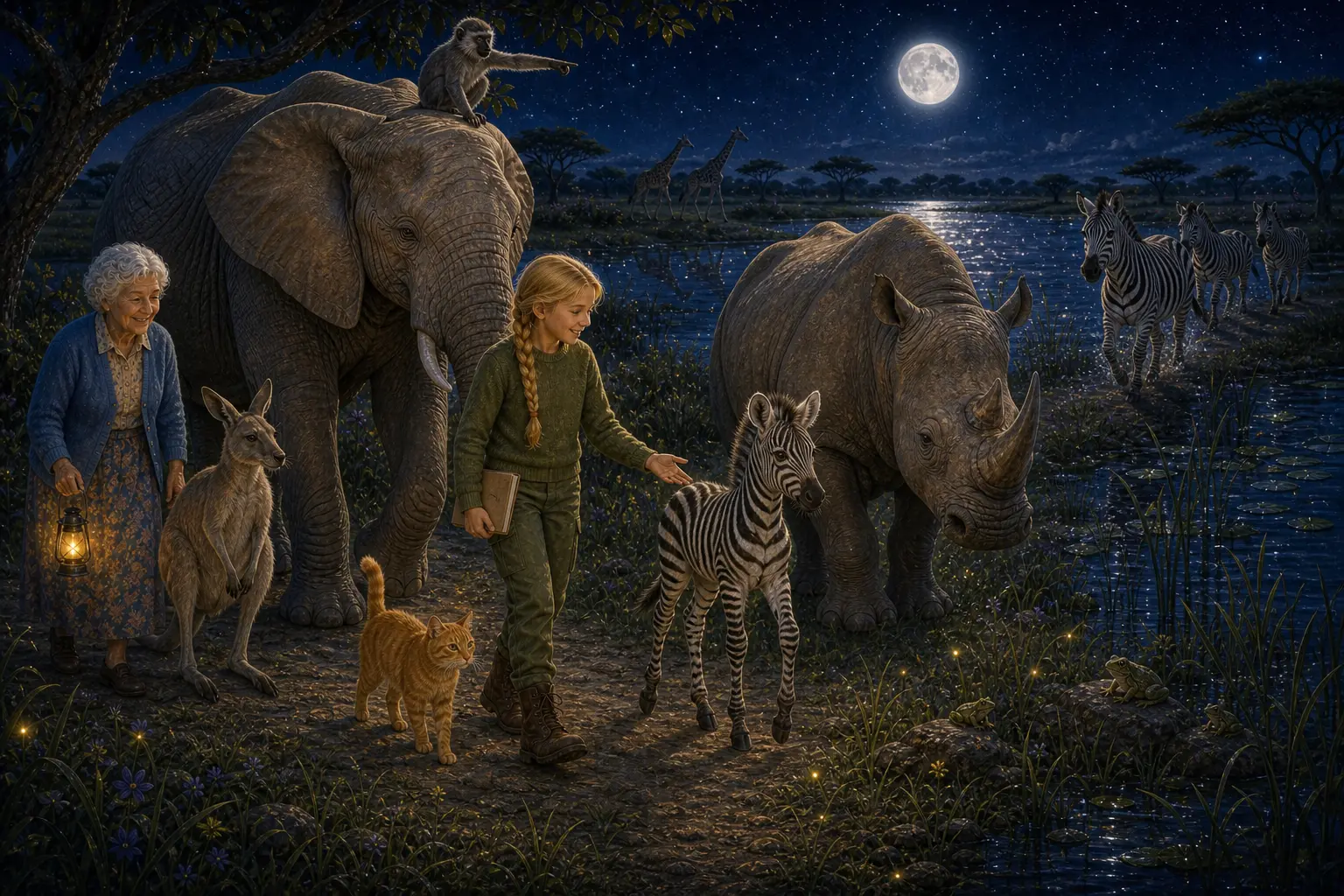
At the far side of the water hole, partly hidden among the reeds, they found a young zebra foal. He was alone, trembling, and clearly frightened. His stripes looked pale in the moonlight, and his ears flicked back and forth nervously.
“Oh, you poor thing,” Lou-Anne whispered.
The foal gave a small, anxious whinny and backed away one step.
“We won’t hurt you,” said Lou-Anne gently.
Omi crouched down beside her. “He’s lost.”
Kiera’s ears drooped. “Where’s his mummy?”
As if in answer, from somewhere beyond the acacia trees came a distant call.
The foal’s head shot up.
Then another call came, louder this time.
“The herd,” said M’Pofo.
Vakawu climbed a low branch to look. “I can see movement near the far path. Zebras.”
The little foal took two uncertain steps, then stopped again, too frightened to move alone into the dark.
Lou-Anne looked at Omi. “Can we help him?”
“We can guide him,” said Omi, “but gently. He must go on his own feet.”
So that was what they did.
M’Pofo moved to one side, making a calm, steady wall. Ubejane took the other side, gruff but reassuring. Kiera stayed just behind, ready in case the foal turned the wrong way. Lou-Anne walked a little ahead, speaking softly to him.
“It’s all right. We hear them too. Come on. Just a little bit.”
The foal hesitated, then followed.
Slowly, step by step, they moved through the moonlit grass toward the sound of the zebra herd. Each time the foal faltered, another call came from ahead.
Then suddenly, from out of the darkness, several adult zebras appeared at a trot.
The foal gave a squeaky little cry and raced forward.
One of the zebras, his mother surely, rushed to meet him and pressed her nose against his neck. The rest of the herd gathered round, snorting softly and shifting close in relief.
Lou-Anne stopped and smiled so widely her cheeks hurt.
“He found them.”
“No,” said Ubejane, in his usual dry way. “We found them. Then he found them.”
“That still counts,” said Kiera.
Vakawu, from his branch, wiped one eye dramatically. “I am moved.”
“You are always moved,” said Ubejane.
The friends returned to their blanket feeling warm and happy inside.
Now the night seemed less mysterious and more full of hidden stories. Every rustle might be a family finding its way. Every ripple might be some creature coming quietly to drink.
They shared the snacks from Omi’s basket: little cheese pieces, apple slices, and biscuits. Marmalade was allowed a tiny bite of chicken, which he accepted as the correct reward for a night’s serious work.
For a while they simply sat and watched.
A pair of bush babies bounded through the branches overhead.
A sleepy tortoise appeared from nowhere and drank as if he had all the time in the world.
Far off, a lion called once into the night, and even M’Pofo fell still to listen.
Lou-Anne leaned against Omi’s shoulder.
“I never knew the water hole had so many secrets,” she whispered.
Omi smiled. “Most places do, if you visit them at the right time and with quiet enough hearts.”
Lou-Anne thought that was one of the loveliest things Omi had ever said.
When at last they walked home, the moon was high and bright above the Savannah. The grass shone silver. The night air smelled cool and clean. Everyone was sleepy in that happy way that only comes after a proper adventure.
Kiera yawned as she hopped. Vakawu whispered less and less until he was mostly mumbling to himself. Ubejane looked tired but content, though he would never have admitted it out loud. Marmalade walked close beside Lou-Anne, his tail brushing her ankle now and then.
Under the baobab tree, they stopped for a final moment before everyone went to bed.
“That,” said Lou-Anne softly, “was magical.”
M’Pofo gave a deep, warm rumble. “The water hole belongs to the day. But it belongs to the night as well.”
“And tonight,” said Omi, “we were lucky enough to see both.”
Lou-Anne looked up at the stars and smiled.
The night at the water hole had not been loud or wild or full of rushing about.
It had been something better.
A quiet adventure.
A moonlit rescue.
A reminder that even while most of the world sleeps, the Savannah is still awake, still moving, still full of life.
And with that lovely thought tucked safely into her heart, Lou-Anne went to bed and dreamed of silver water, zebra stripes, and stars.