
Story 45
Lou-Anne and the Day of the Great Heat
8 minute read · Nature and hot-weather care
The sun rose early over the Savannah, and even in the morning the air already felt strange.
Heavy. Still. Hot.
By the time Lou-Anne stepped out from the shade of the baobab tree, the grass was already warm under her shoes and the stones were beginning to hold the heat.
M’Pofo stood near the water trough, flapping his ears slowly.
“It is going to be a very hot day,” he said.
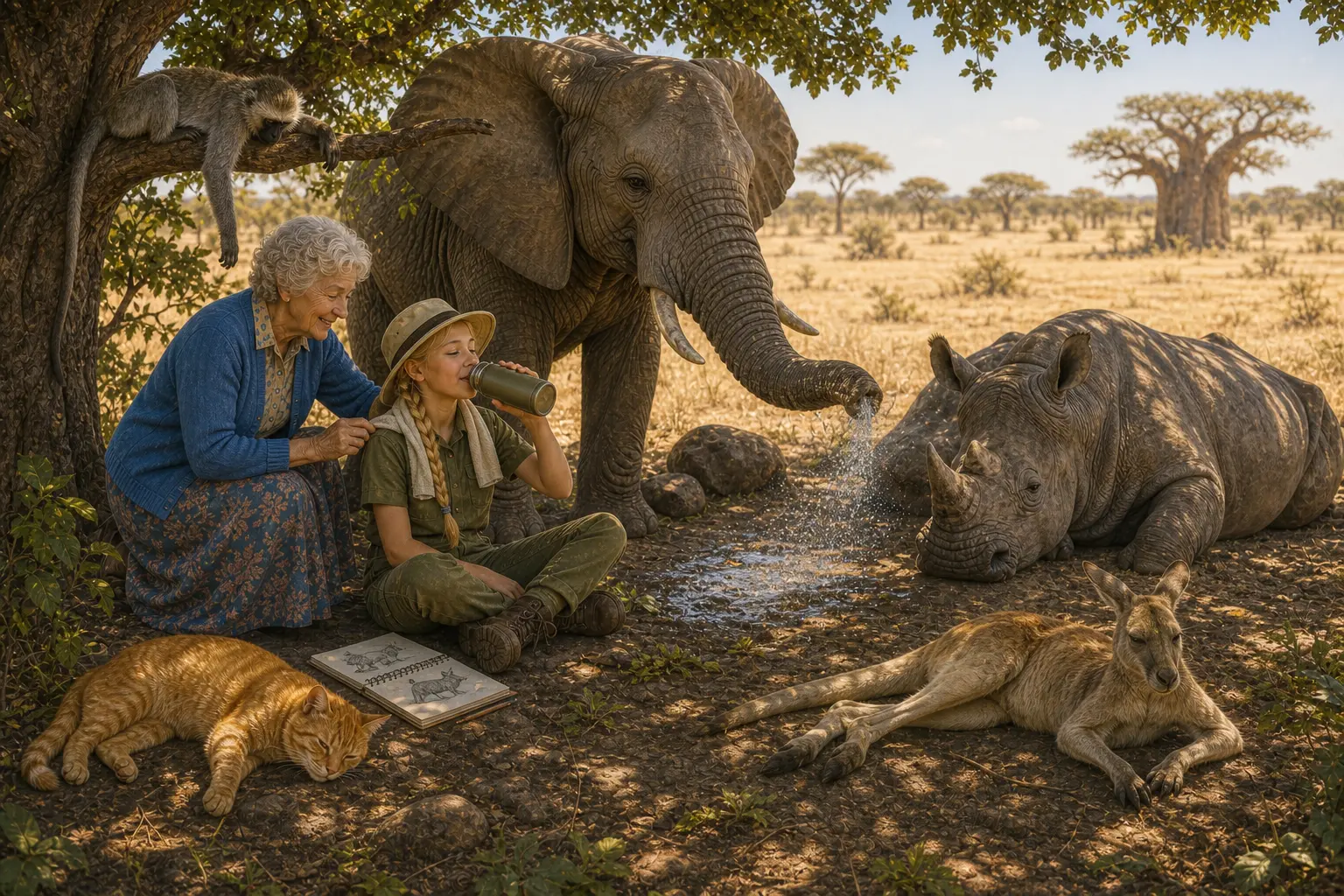
Kiera was lying flat in the shade with her ears drooping. Vakawu had stopped leaping about and was stretched along a branch like an abandoned scarf. Even Ubejane, who normally insisted he was perfectly fine in all circumstances, had chosen a patch of shadow and was refusing to move.
Marmalade had found the coolest patch of dirt under a bush and looked up at Lou-Anne with the expression of someone who had no intention of doing anything ambitious until October.
Lou-Anne fanned herself with her hat. “How hot is it?”
Omi, who had just come up the path with a water bottle in each hand, said, “Thirty-seven degrees.”
Vakawu opened one eye. “That sounds illegal.”
“It sounds like a day for sensible choices,” said Omi.
Lou-Anne sat down in the shade beside M’Pofo.
“What do animals do when it gets this hot?” she asked.
M’Pofo lifted his trunk. “We rest more.”
Kiera added, “And we stay in the shade.”
Ubejane grunted, “And we do not run around like fools.”
Vakawu sighed. “There goes my afternoon plan.”
Omi nodded approvingly. “Exactly right. On very hot days, the clever thing is not to fight the heat. It’s to work around it.”
Lou-Anne listened carefully.
“First rule,” said Omi, holding up a finger, “drink often, even before you feel very thirsty.”
She handed Lou-Anne a bottle of water.
Lou-Anne took a long drink.
“Second,” said Omi, “stay in the shade as much as possible, especially in the hottest hours.”
“Third,” rumbled M’Pofo, “save games and running for the early morning or evening.”
“Fourth,” said Kiera, “wear a hat.”
Lou-Anne put hers back on properly.
“Fifth,” said Omi, “light clothes help. And if your neck or wrists feel hot, cool them with water.”
Vakawu perked up slightly. “Do snacks count as cooling?”
“Only if they come with water,” said Omi.
As the sun climbed higher, the heat became fierce.
The birds went quiet. The breeze disappeared. The whole Savannah seemed to shimmer.
M’Pofo led everyone to a patch of deep shade near some rocks where the ground stayed cooler. Omi brought a damp cloth for Lou-Anne’s neck and another for her wrists.
“That helps a lot,” Lou-Anne said.
“It does,” said Omi. “Also, no charging about in the middle of the day.”
Ubejane looked smug. “I have been saying this for years.”
Marmalade rolled onto one side and stretched one paw into the air as if agreeing with ancient wisdom.
To pass the time without overheating, Lou-Anne and the others chose quiet things to do. Lou-Anne sketched in her notebook. Vakawu told stories from the branch above, though more slowly than usual. Kiera made up a guessing game about clouds, even though there were hardly any. M’Pofo gently sprayed a little water onto the dusty ground to cool the air nearby.
“That,” said Lou-Anne, “is lovely.”
“It is one of elephant society’s great achievements,” said M’Pofo.
After a while, Lou-Anne noticed that the heat was making her feel tired and cross.
“Omi,” she said, “is that normal?”
“Yes,” said Omi. “Very hot weather can make you feel sleepy, grumpy, headachy, or slow.”
Vakawu nodded dramatically. “I feel all of those. Also artistic.”
“That one is unrelated,” said Ubejane.
Omi crouched beside Lou-Anne. “If you ever feel dizzy, sick, confused, or get a pounding headache in heat, that is a sign to stop, cool down fast, and get help straight away.”
Lou-Anne nodded seriously.
“Sit in shade, sip water, cool your skin, and tell a grown-up at once,” said Omi.
“Good rule,” said Lou-Anne.
“A very good rule,” said Omi.
At last, when the afternoon began to soften and the worst of the heat had passed, the air moved again.
A little breeze touched the grass.
The birds started singing once more.
Even Vakawu sat up.
Kiera bounced to her feet. “Can we move now?”
“Yes,” said Omi, “but gently.”
So they all walked to the water hole in the cooler evening light. M’Pofo stood ankle-deep at the edge. Kiera dipped her paws. Marmalade drank, then sat on a warm rock as if he had personally survived a terrible trial. Ubejane found a muddy patch and looked deeply content.
Lou-Anne knelt by the water and splashed her face.
“That’s much better.”
Omi smiled. “See? Hot days are manageable if you’re sensible.”
Vakawu grinned. “So the lesson is: be boring.”
“The lesson,” said Omi, “is: be smart.”
M’Pofo nodded. “And drink water.”
“And stay shady,” said Kiera.
“And no running about at noon,” muttered Ubejane.
“And maybe a cool cloth on the neck,” said Lou-Anne.
Marmalade blinked slowly.
“And nap,” Lou-Anne added.
At that, everyone agreed.
That evening, under the softer sky, Lou-Anne wrote the day’s hot-weather rules in her notebook:
- Drink water often
- Stay in the shade
- Wear a hat
- Keep clothes light
- Save games for cooler hours
- Cool your neck and wrists
- Rest if you feel tired
- Tell a grown-up if you feel dizzy or ill
Then she smiled and drew a little picture of Marmalade sleeping under a bush.
Because if there was one thing the animals knew better than anyone, it was this:
On a scorching hot day, the cleverest creature is the one who slows down.