
Story 54
Lou-Anne and the Great Mosquito Invasion
21 minute read · Weather safety and nature
The day began with a wind so strong that it made the Savannah seem as though it had forgotten how to sit still.
The tall grass bent and swayed in great golden waves. Leaves spun through the air, loose twigs bounced across the ground, and the branches of the old baobab creaked and groaned above Lou-Anne and her friends.
Lou-Anne held onto her sun hat with both hands.
“I thought we were going to have a quiet day,” she called over the wind.
M’Pofo stood beside her with his enormous ears flapping behind him.
“So did I,” he replied. “But the weather appears to have made other arrangements.”
Kiera tried to hop across the clearing, but a sudden gust caught her from the side and sent her bouncing into a soft bush.
“I meant to do that,” she announced, emerging with several leaves stuck to her ears.
Vakawu was having much more fun. He swung from branch to branch, allowing the wind to carry him farther than usual.
“Look at me!” he shouted. “I am flying!”
“You are clinging to a tree,” Ubejane called from below.
“Most flying involves holding onto something.”
“No, it does not.”
Marmalade had no interest in debating the matter. He crouched behind M’Pofo’s front leg with his orange fur puffed out by the wind. Every few seconds, another leaf rolled past him, and he slapped it firmly with one paw.
Nuru and Buhala chased the smaller leaves through the grass while Batenga tried to catch a large one and wear it as a hat. The leaf blew away each time he reached for it, which only made him more determined.
Then Lou-Anne felt something cool touch her nose.
A raindrop.
Another landed on her cheek.
Within moments, a light drizzle began to fall.
It was not heavy enough to send everyone running for shelter, but the wind blew the fine rain in every direction. It landed on backs, noses, tails and ears, no matter which way anyone turned.
Ubejane frowned at the sky.
“This is hardly proper rain,” he complained. “It cannot decide whether it is arriving or leaving.”
“It smells lovely,” said M’Pofo.
The warm earth released a fresh, rich scent as the drops touched the dust. The grass darkened, and tiny beads of water collected along the leaves.
Lou-Anne lifted her face towards the drizzle.
“I like it.”
Marmalade did not. He ran beneath the baobab tree, discovered that the wind was blowing the rain under its branches, and hurried into Lou-Anne’s little shelter instead.
Batenga followed him.
“Move over,” said Batenga.
Marmalade took up as much space as one small cat possibly could.
By late afternoon, the drizzle stopped. The wind softened too, leaving the Savannah fresh, damp and strangely quiet.
Little puddles gleamed between the rocks. Water had collected inside curled leaves, old tree hollows and shallow hoofprints. The air was still warm, but it no longer felt dusty.
Lou-Anne stepped outside and breathed deeply.
“What a day.”
M’Pofo looked towards the western sky. “The clouds are breaking.”
A stripe of golden sunlight appeared beneath them, making the wet grass shine.
Kiera bounced into the clearing. “Can we have supper outside?”
“That sounds wonderful,” said Lou-Anne. “We can eat beneath the baobab.”
Everyone agreed, even Ubejane, who said he would agree only if supper arrived soon and contained no unnecessary salad.
They began preparing the clearing.
M’Pofo carried a low table into the shade. Kiera gathered cushions. Nuru and Buhala collected the cups, making several trips because each mongoose could carry only one at a time.
Vakawu and Batenga were told to hang lanterns from the lower branches.
This instruction required more trust than it probably deserved.
Lou-Anne spread a cloth across the table while Marmalade inspected every cushion before choosing the largest one for himself.
Omi and Opi arrived just before sunset with a basket of sandwiches, vegetable pastries, sliced fruit and a jug of homemade lemonade.
“The clearing looks lovely,” Omi said.
A lantern immediately fell out of the tree and landed upside down beside her.
Vakawu leaned down from a branch.
“We are still making final improvements.”
Opi looked at the remaining lanterns, which hung at several unusual angles.
“I can see that.”
Soon everyone gathered around the table. The wind had become no more than a gentle breeze, and the clouds glowed pink and orange in the evening light.
For several peaceful minutes, they ate and talked.
Then Lou-Anne heard a faint buzzing near her ear.
She waved one hand beside her head.
The buzzing stopped.
A moment later it returned.
Bzzzzzz.
Lou-Anne slapped gently at the air.
“Is something bothering you?” Omi asked.
“There’s a mosquito.”
Vakawu scratched his shoulder.
“There may be two.”
Kiera flicked one ear.
“Or three.”
M’Pofo suddenly flapped both of his ears.
A small cloud of mosquitoes had appeared above the damp grass.
More rose from the puddles and wet hollows left by the drizzle. They buzzed around the lanterns, circled everyone’s heads and landed on any ankle, paw or trunk they could find.
Marmalade snapped at one as it flew past his whiskers.
Then another landed on his nose.
He crossed his eyes trying to see it.
The mosquito flew away just before Marmalade swatted himself in the face.
Ubejane stamped one foot.
“I object.”
“So do I,” said Lou-Anne, scratching her ankle.
Vakawu waved both arms around his head. “We are under attack!”
“They’re mosquitoes, not an army,” Opi said.
“They have wings, numbers and a clear lack of manners. That is close enough.”
Batenga picked up two large leaves and began swatting wildly at the air.
“Stand back! I’ll protect everyone!”
He spun in a circle, missed every mosquito and knocked Vakawu’s party hat into the lemonade jug.
There was a small splash.
Everyone stared at him.
Batenga lowered the leaves.
“Some sacrifices are unavoidable.”
Omi rescued the hat from the jug.
“Let’s handle this calmly.”
“Calmly?” said Ubejane. “One has just bitten me behind the ear.”
Lou-Anne looked around at the damp clearing. “Why are there suddenly so many?”
“The drizzle left little pockets of water everywhere,” Omi explained. “Mosquitoes need still water for breeding, although these adults were already nearby. The damp, quiet evening has brought them out.”
“So how do we make them leave us alone?” asked Kiera.
“We start by protecting ourselves properly,” said Omi.
Operation Mosquito Defence began immediately.
Opi brought out loose, lightweight shirts with long sleeves. Lou-Anne pulled one over her clothes and tucked her trousers into her socks.
Vakawu stared at her feet.
“That is not your most fashionable arrangement.”
“It’s better than itchy ankles.”
Vakawu looked down at the mosquitoes circling his own legs.
“Fashion is sometimes required to make difficult compromises.”
Kiera covered her arms and shoulders with a light cotton wrap. Omi helped fasten thin cloth around the areas where her fur was shortest.
Marmalade did not need clothing, but Omi moved him away from the wet grass and placed his cushion on the veranda, where the mosquitoes were less troublesome.
M’Pofo sprayed a fine mist of water over his back, then coated himself with a light layer of mud.
Ubejane was delighted.
“At last,” he said. “A sensible medical treatment.”
“It helps protect their skin from insects,” Lou-Anne explained.
“I know,” Ubejane replied, settling into a muddy patch. “That is why I have always taken my health extremely seriously.”
M’Pofo used his trunk to place a little mud behind Ubejane’s ears, where he could not reach.
Ubejane sighed with relief.
“That is much better.”
Next, Opi brought out a mosquito net and hung it over a quiet corner of the veranda.
“This will give anyone who needs a rest somewhere protected to sit,” he said.
Marmalade walked beneath it at once, circled twice and lay down.
“He appears to have reserved the entire protected area,” said Kiera.
Lou-Anne lifted one edge and crawled underneath beside him. “He can share.”
Marmalade looked disappointed but permitted it.
Omi applied a child-safe insect repellent to Lou-Anne’s exposed skin, carefully following the instructions on the bottle.
“Repellent goes on exposed skin and clothing as directed,” she explained. “Never near your eyes or mouth, and you wash it off when you come indoors.”
Vakawu held out both arms.
“May I have some?”
“You may, but you are not applying it yourself.”
“Why not?”
Omi looked at Batenga’s lemonade-soaked hat and then back at Vakawu.
“Experience.”
While Omi helped the others, Lou-Anne noticed that the mosquitoes were gathering around the lanterns.
“Could the lights be attracting them?”
“Some insects are attracted to light,” Opi said. “Let’s move the brightest lanterns away from where we’re sitting.”
M’Pofo carried the lantern stand to the far side of the clearing. Almost at once, some of the buzzing moved with it.
“That helped,” said Kiera.
“But there are still too many,” Lou-Anne replied.
She looked around at all the little pools left by the drizzle.
One had formed inside an old bucket. Another sat in a turned-over pot. Several smaller pools had collected in sheets of bark and curled leaves.
“We should empty anything that is holding water,” she said.
“Good thinking,” said Omi. “Mosquitoes cannot complete their early life cycle without water. Removing unnecessary standing water helps prevent more of them appearing later.”
The friends spread out to inspect the clearing.
Lou-Anne tipped the rainwater from the old bucket onto the roots of a thirsty shrub. Kiera emptied the flowerpots and placed them upside down.
Nuru and Buhala searched for tiny containers near the ground.
“Bottle top!” called Nuru.
“Half a coconut shell!” called Buhala.
“Vakawu’s missing cup!” called Nuru.
Vakawu stared at it.
“I wondered where that went.”
“It has been behind the tree for three weeks,” said Ubejane.
“I was storing it.”
“You were losing it slowly.”
M’Pofo used his trunk to empty water from a hollow log, directing it onto dry ground where it would soak away. Ubejane filled several deep hoofprints with loose soil.
Batenga found a tray filled with rainwater and lifted it above his head.
“I have one!”
“Tip it away from everyone,” Opi warned.
Batenga tipped it directly over Vakawu.
Vakawu stood dripping beneath him.
“That,” he said, “felt intentional.”
Batenga grinned.
“It was slightly intentional.”
Vakawu grabbed a wet sponge from the table and chased him around the baobab tree.
“Walk,” Omi called after them. “The ground is slippery.”
They continued chasing each other, but at a noticeably more responsible speed.
Once the containers had been emptied, Lou-Anne looked towards the natural puddles.
“What about those?”
“We leave natural habitats alone unless they are causing a problem around the house,” Omi said. “They belong to frogs, insects and other wildlife. We only remove unnecessary standing water from things such as buckets, pots and containers.”
A chorus of croaking came from the reeds beyond the clearing.
M’Pofo raised his trunk. “The frogs are awake.”
As darkness settled, several little frogs appeared near the damp grass. They sat beneath leaves and beside the shallow puddles, watching the mosquitoes with great interest.
Then one frog flicked out its tongue.
A mosquito disappeared.
Another frog did the same.
Kiera smiled. “They’re helping us.”
“So are the bats,” said Opi.
Small dark shapes were darting through the air above the clearing. They swooped and turned with astonishing speed, feeding on flying insects.
Vakawu stopped chasing Batenga and looked up.
“We have air support.”
“Natural balance,” Omi corrected.
“Natural air support.”
Lou-Anne watched the bats pass through the fading light.
“We shouldn’t try to get rid of every mosquito, should we?”
“No,” said Omi. “Mosquitoes are part of the food web. Other animals depend on them. We simply need to stop them breeding around the house and protect ourselves from bites.”
Ubejane flicked one ear.
“I remain willing to negotiate their continued existence, provided they respect my personal space.”
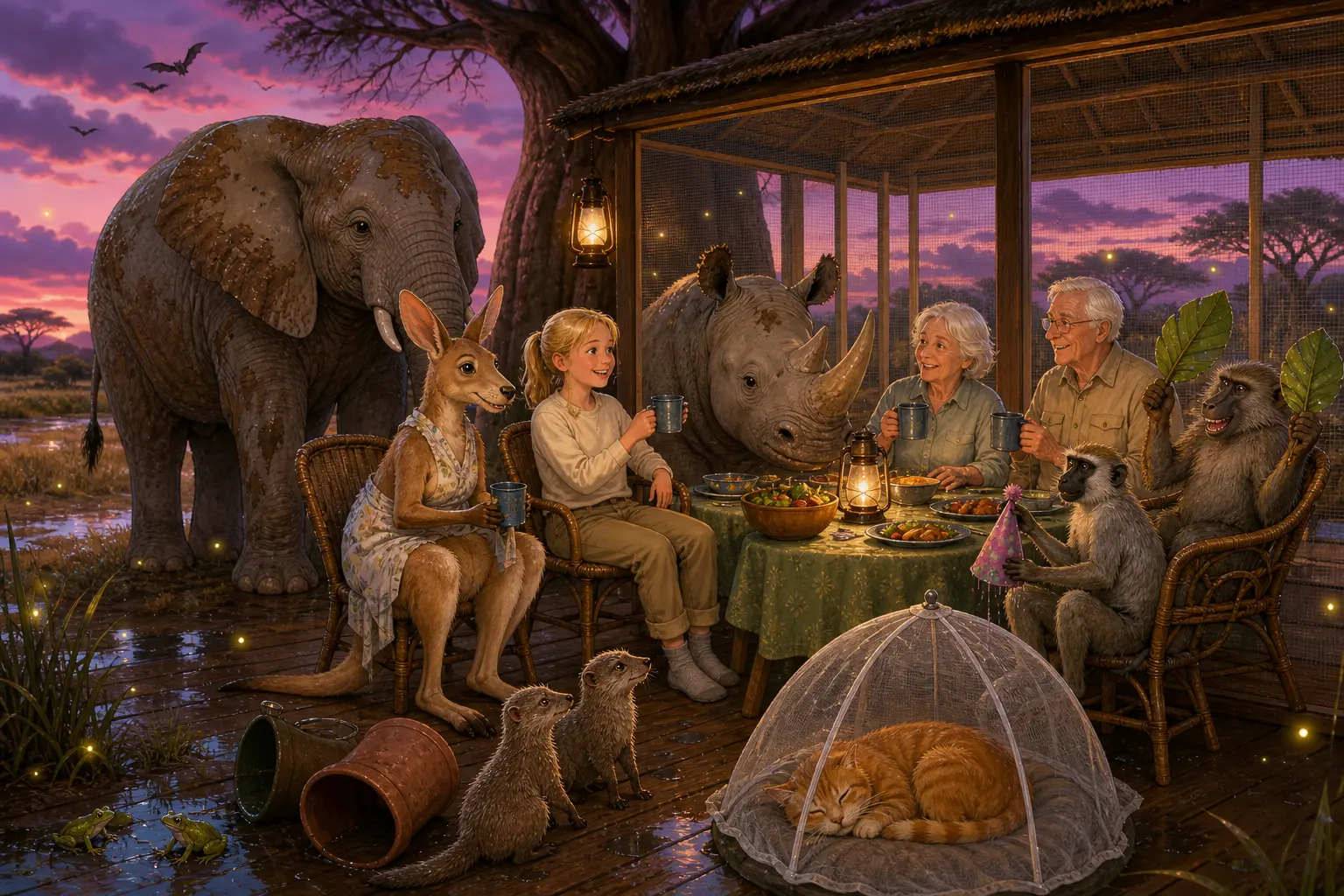
The friends moved their supper onto the screened veranda, where Opi had checked the doors and windows for gaps. The mosquitoes remained outside, while the frogs and bats continued their evening hunt.
Batenga and Vakawu were permitted to carry the lemonade jug together. Omi decided that two troublemakers sharing one important job might somehow balance each other.
Against all expectations, the jug reached the table safely.
Everyone settled down to finish the meal.
Lou-Anne sat beneath the mosquito net with Marmalade curled beside her. The air smelled of damp grass and warm pastries. Beyond the veranda, fireflies began blinking among the trees.
M’Pofo stood close to the open screen, enjoying the cooler evening breeze. Ubejane’s ears were protected by a magnificent layer of mud. Kiera shared fruit with Nuru and Buhala, while Vakawu carefully squeezed the water from his party hat.
Batenga leaned towards him.
“Are you still cross?”
“Yes.”
“Would you like a pastry?”
Vakawu considered this.
“I am now only partly cross.”
Omi handed Lou-Anne a cool cloth for the mosquito bite on her ankle.
“Try not to scratch it,” she said. “Wash the area and use something cool to soothe the itching. Tell a grown-up if a bite becomes unusually swollen, painful or makes you feel unwell.”
Lou-Anne pressed the cloth gently against her skin.
“That feels better.”
Opi checked the veranda one last time.
“We’ve emptied the containers, moved the lights, covered ourselves, used repellent properly and put up the net. I think our mosquito defence has succeeded.”
Vakawu listened.
The clearing was still alive with evening sounds, but the annoying buzz around their heads had disappeared.
“We have won,” he declared.
“We have adapted,” said M’Pofo.
“That sounds less exciting.”
“It is more accurate,” Ubejane replied.
Lou-Anne smiled. “Maybe living with nature isn’t about defeating everything that bothers us. Sometimes it’s about understanding it and making sensible changes.”
Omi nodded. “That is usually the kinder and more effective approach.”
The blustery day had finally become a peaceful night. Water still shone on the grass, frogs sang beside the reeds, and bats swooped beneath the first stars.
Inside the veranda, the friends were dry, comfortable and mostly bite-free.
Marmalade rolled onto his back beneath the mosquito net.
Vakawu’s hat dried on the railing.
Batenga quietly stole half of Vakawu’s pastry.
Ubejane caught him.
“I saw that.”
Batenga froze.
Vakawu looked at his plate.
For a moment, everyone was silent.
Then Batenga broke the pastry into two pieces and handed the larger one back.
“Peace offering?”
Vakawu accepted it.
“Mosquito emergencies require unity.”
Lou-Anne laughed.
The mosquitoes had not exactly been fought off with dramatic battles or heroic leaf-swatting. Batenga’s attempt had proved that.
Instead, the friends had used sleeves, nets, repellent, careful cleaning and a little knowledge about the creatures sharing their home.
As Lou-Anne watched the fireflies outside, she wrote the evening’s lessons in her notebook:
Wear light, loose clothing that covers the skin.
Use insect repellent with a grown-up’s help.
Sleep or rest beneath a mosquito net when needed.
Keep doors and window screens closed or properly fitted.
Empty unnecessary standing water from buckets, pots and containers.
Do not disturb natural pools or wildlife habitats without a good reason.
Cool itchy bites and try not to scratch them.
Tell a grown-up if a bite causes unusual swelling or illness.
At the bottom of the page, she added one final rule:
Never allow Batenga to defend the lemonade with two large leaves.
Batenga read it over her shoulder.
“That seems unnecessarily specific.”
“It is based on evidence,” said Lou-Anne.
Outside, a mosquito buzzed past the screen and disappeared into the night.
Inside, the Savannah friends shared the final pastries, safe and comfortable together.
The day had brought wind, drizzle, mud, mosquitoes and minor lemonade trouble.
In other words, Lou-Anne thought, it had been a fairly ordinary Savannah adventure.