
Story 55
Lou-Anne and the Little Owl Who Was Afraid of the Dark
17 minute read · Courage, darkness and friendship
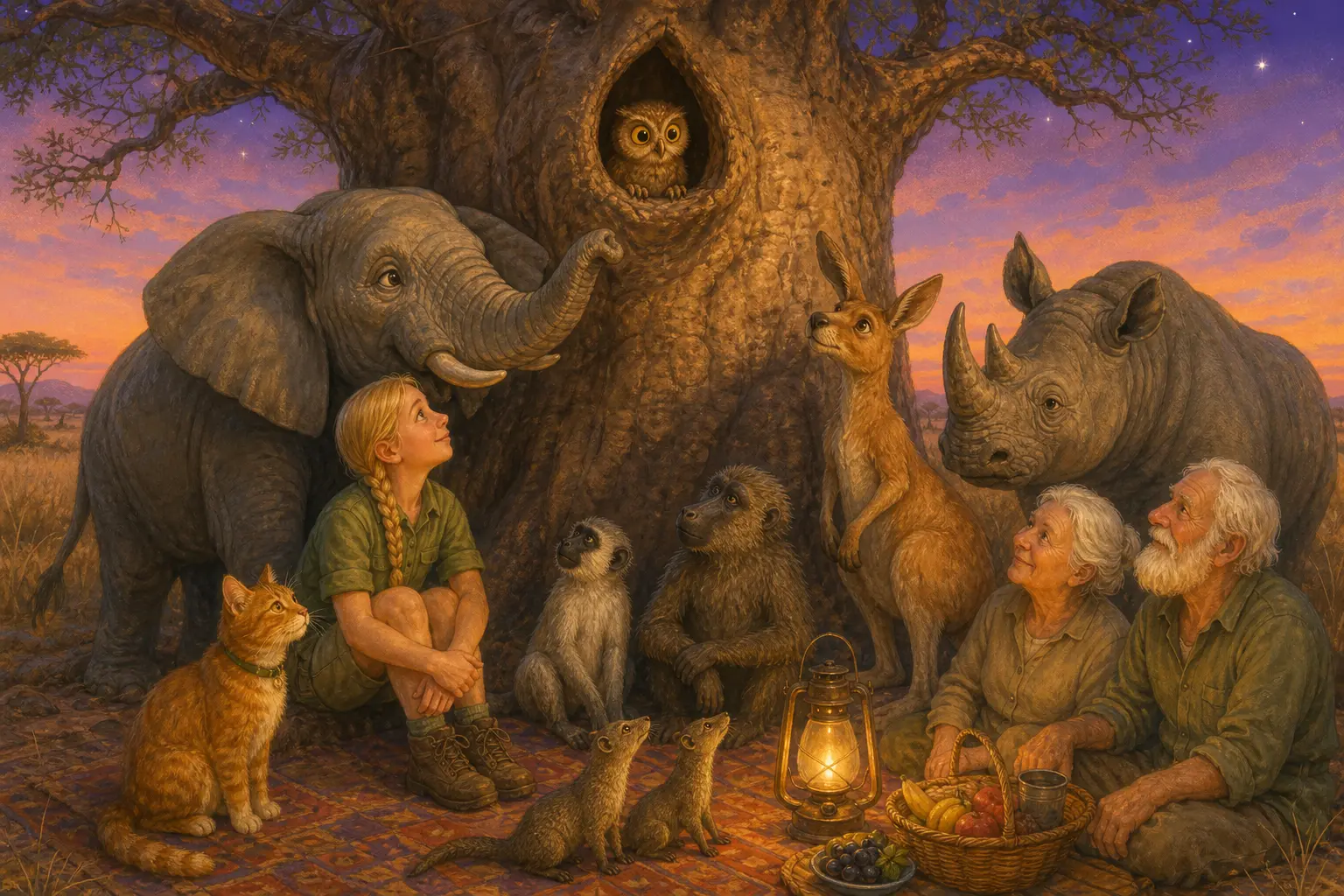
The sun was sinking behind the Savannah when Lou-Anne and her friends gathered beneath the old baobab tree.
The sky glowed orange and pink, and the tall grass moved gently in the evening breeze. M’Pofo stood beneath the broad branches, using his trunk to collect fallen seed pods. Kiera practised hopping between the tree’s enormous roots, while Nuru and Buhala chased one another through the grass.
Vakawu and Batenga were arguing about which of them could climb to the highest branch.
“I can climb higher,” said Vakawu.
“You can only climb noisier,” Batenga replied.
Ubejane was trying to enjoy a peaceful rest, although the two monkeys were making that nearly impossible. Marmalade sat beside Lou-Anne, watching a beetle crawl across her sketchbook.
Omi and Opi were preparing a small evening picnic nearby. They had brought warm vegetable pastries, apple slices and a flask of cocoa for Lou-Anne.
“It will be dark soon,” Omi said. “We should light the lantern.”
Just then, a tiny sound came from somewhere above them.
“Peep.”
Lou-Anne looked up.
“Did anyone hear that?”
“Hear what?” asked Kiera.
“Peep.”
This time, everyone heard it.
M’Pofo lifted his trunk towards the branches. Vakawu and Batenga stopped arguing. Even Ubejane opened his eyes.
“It came from the tree,” said Lou-Anne.
Vakawu climbed carefully through the branches. A moment later, he called down.
“There’s a little owl up here!”
“That is not surprising,” Ubejane said. “Owls generally prefer trees.”
“This one is hiding behind the trunk,” Vakawu replied. “And he’s trembling.”
Lou-Anne climbed onto M’Pofo’s back so that she could see more clearly. High above her, tucked into a hollow in the baobab, was a small owl with soft brown feathers and enormous golden eyes.
“Hello,” Lou-Anne said gently. “Are you all right?”
The little owl shook his head.
“My name is Piko,” he whispered. “And no, I am not all right.”
“What happened?” asked Lou-Anne.
Piko looked towards the fading sunlight.
“It’s nearly night.”
“Yes,” said Vakawu. “That does happen after evening.”
Lou-Anne gave him a warning look.
Vakawu covered his mouth.
Piko shuffled deeper into the hollow.
“I don’t like the dark,” he admitted. “Everything disappears. The branches look strange, the grass makes noises, and I can’t see what might be hiding below.”
Batenga scratched his head.
“But you’re an owl. Aren’t owls supposed to enjoy the night?”
Piko’s feathers drooped.
“That’s what everyone says. My brothers fly as soon as the sun sets. They hunt moths and explore the trees. They laugh because I stay in the nest.”
Lou-Anne felt sorry for him. Being frightened was difficult enough without someone making you feel ashamed of it.
“It’s all right to be afraid,” she said. “You don’t have to pretend with us.”
Piko peered down at her.
“Really?”
“Really,” M’Pofo answered. “Everyone is frightened sometimes.”
“Not me,” said Vakawu.
A dry leaf fell onto his shoulder.
Vakawu jumped and grabbed Batenga.
Ubejane raised one eyebrow.
Vakawu released Batenga and straightened himself.
“I was checking whether he was paying attention.”
Nobody believed him.
The First Shadows
The final edge of the sun disappeared.
Almost at once, the Savannah began to change. The gold faded from the grass, and shadows gathered between the trees. The sky turned from pink to purple, then slowly deepened towards blue.
Piko pressed himself against the tree trunk.
“It’s happening.”
Lou-Anne climbed down from M’Pofo’s back.
“We won’t make you fly,” she said. “Why don’t you stay where you feel safe and look at the night with us?”
Opi lit the lantern, but Omi kept its flame low.
“If the light is too bright, our eyes won’t adjust to the darkness,” she explained. “We need to give them time.”
The friends settled beneath the baobab. Lou-Anne wrapped a blanket around her shoulders, and Marmalade curled beside her.
At first, the darkness seemed to swallow everything beyond the lantern.
Then, little by little, shapes returned.
Lou-Anne could see M’Pofo’s great ears. She could make out the curve of Ubejane’s back and the outline of Kiera’s long tail. The baobab’s branches appeared against the sky like enormous dark fingers.
“I can see more now,” Piko whispered.
“Your eyes are learning to use the light that is still there,” said Omi. “Darkness is rarely completely dark.”
A bright point appeared above the horizon.
Then another.
Soon, stars began to cover the sky.
Piko leaned out of the hollow.
“They’re beautiful.”
“They were there before,” Lou-Anne said. “We just couldn’t see them while the sun was shining.”
Piko thought about that.
“So night does not only hide things?”
“No,” said M’Pofo. “It reveals things too.”
The Noise in the Grass
A sudden rustle came from the long grass.
Piko vanished back into the hollow.
“What was that?”
Marmalade stood up, his tail twitching. Nuru and Buhala moved closer together.
The grass rustled again.
Ubejane rose to his feet.
“Stay behind me.”
Vakawu climbed onto a low branch, and Batenga joined him. Lou-Anne remained close to M’Pofo while Opi raised the lantern slightly.
Two small shapes emerged from the grass.
They were hares.
One stopped to nibble a plant while the other cleaned its ears.
Kiera gave a quiet laugh.
“They’re only having their supper.”
Piko looked embarrassed.
“I thought it might be something dangerous.”
“You heard something you couldn’t see,” Lou-Anne said. “Your mind filled in the missing part. Mine does that too.”
Omi nodded.
“When something frightens us, it helps to stop and listen carefully before deciding what it is.”
The hares hopped away, and the grass became still again.
Piko moved to the edge of the hollow.
He was not ready to leave it, but he was no longer hiding.
The Savannah’s Night Orchestra
As the night deepened, more sounds began around them.
Crickets chirped beneath the roots. Frogs called from the distant water hole. A nightjar made a soft, repeating whistle, and somewhere beyond the trees a jackal called to its family.
Piko’s head turned from side to side.
“The Savannah is so noisy at night.”
“It is a different kind of noise,” said Opi. “During the day, everyone seems to speak at once. At night, you can often hear each voice separately.”
M’Pofo closed his eyes.
“Crickets near the roots,” he said.
“Frogs towards the water,” Kiera added.
“Something eating a biscuit beside the picnic basket,” said Ubejane.
Everyone turned towards Vakawu.
Vakawu was holding half a pastry.
“That sound could have come from anywhere.”
“It came from your mouth,” said Ubejane.
Piko made a tiny hooting sound.
Lou-Anne smiled.
“Was that a laugh?”
“No,” said Piko, although his eyes looked brighter.
Another sound fluttered through the branches.
A pale moth danced around the leaves.
Piko watched it closely. Without realising what he was doing, he stepped out of the hollow and onto the branch.
The moth drifted towards him, then floated away.
Piko followed it for two small steps before stopping.
“I’m outside.”
“You are,” said Lou-Anne.
“And it’s dark.”
“It is.”
Piko looked around.
The darkness had not disappeared. The branches still cast strange shadows, and the grass still whispered below. But now he could also see the stars, hear the frogs and recognise the gentle shapes of his new friends beneath the tree.
“It doesn’t feel quite as dark as it did before,” he said.
A Light Among the Trees
A small golden light appeared between the bushes.
Piko froze.
The light vanished.
Then it appeared again in another place.
“There’s something glowing down there!”
Another light blinked beside it. Then five more flickered among the grass.
“Fireflies,” Lou-Anne said.
Piko stared in wonder.
“They look like tiny stars.”
“Stars with wings,” Kiera said.
The fireflies drifted around the baobab, blinking softly. One floated close to Piko’s branch. He leaned towards it, his fear temporarily forgotten.
Then a gust of wind moved through the tree.
The branch swayed.
Piko opened his wings in surprise.
For one breathless moment, he balanced at the edge.
Then he fluttered down to a lower branch.
Everyone remained very still.
Piko looked back at the hollow above him.
“I flew.”
“Only a little,” said Lou-Anne. “But you did it.”
Piko looked at the next branch. It was lower still and only a short distance away.
He opened his wings again.
This time, he chose to fly.
He landed safely and gripped the bark with both feet.
M’Pofo gave a quiet, pleased rumble.
Piko flew once more, circling the baobab before returning to the tree.
“I could see everything!” he exclaimed. “The grass, the rocks and all of you!”
Vakawu placed both hands on his hips.
“You almost flew as beautifully as I climb.”
“You fell out of this tree yesterday,” Batenga reminded him.
“That was a rapid descent.”
Piko laughed properly this time, a cheerful little series of hoots that echoed through the branches.
The Walk to the Water Hole
Piko was feeling braver, but Lou-Anne did not want him to rush.
“Would you like to come with us to the water hole?” she asked. “You can fly beside us or sit on M’Pofo if you get tired.”
Piko looked towards the moonlit path.
The water hole seemed a long way away.
“What if I become frightened again?”
“Then you tell us,” Lou-Anne replied. “Being brave doesn’t mean fear never comes back.”
Piko considered this and nodded.
The friends set out together.
Opi carried the low lantern. M’Pofo walked beside Lou-Anne, and Piko rode between his great ears. Kiera hopped gently along the path. Nuru and Buhala scouted just ahead, while Ubejane brought up the rear.
Vakawu and Batenga whispered ridiculous ghost stories until Omi told them that stories intended to frighten a nervous baby owl were neither kind nor clever.
Marmalade moved silently through the silver grass, looking far more at home in the darkness than anyone had expected.
At the water hole, moonlight shimmered on the surface. Frogs sat among the reeds, and bats swooped overhead, catching insects in the air.
Piko gazed at them.
“They aren’t frightened.”
“They know this world,” said Lou-Anne. “You’re learning it too.”
Piko flew from M’Pofo’s head to a nearby branch.
A moth fluttered past.
He followed it, gliding between two trees before turning and flying back.
This time, he did not rush to land.
He spread his wings and let the cool night air hold him.
Home Beneath the Stars
When they returned to the baobab, Piko’s mother was waiting.
She swept down from the upper branches and gathered him beneath one wing.
“I was worried,” she said. “Where did you go?”
“To the water hole,” Piko answered proudly. “I saw fireflies, frogs, bats and stars. I flew between the trees, and I wasn’t frightened all the time.”
His mother smiled.
“Not all the time?”
Piko shook his head.
“I was frightened when the grass moved. I was frightened when the branch shook. And I might be frightened again tomorrow.”
Lou-Anne waited to hear what his mother would say.
“That’s all right,” she replied. “Courage grows a little at a time.”
Piko looked down at his new friends.
“Will you come out with me again tomorrow night?”
“We would love to,” said Lou-Anne.
Ubejane yawned.
“Perhaps not every night.”
They shared the last of the picnic beneath the stars. Omi poured warm cocoa for Lou-Anne, while Opi handed out apple slices. Marmalade climbed into Lou-Anne’s lap and began to purr.
High in the baobab, Piko settled beside his mother. The darkness surrounded him just as it had before.
But now it was filled with things he knew.
There were crickets beneath the roots, frogs beside the water and bats above the grass. There were fireflies among the reeds and friends beneath the tree. There were stars watching over everything.
The night was still mysterious.
It was still very large.
But it no longer felt empty.
“Goodnight, Lou-Anne,” Piko called softly.
“Goodnight, Piko.”
Lou-Anne rested her head against M’Pofo’s side and looked up at the little owl silhouetted against the moon.
Piko had not defeated the darkness. He had done something more useful.
He had discovered what lived inside it.
And as the Savannah settled into its gentle night-time song, the little owl closed his golden eyes, knowing that when he opened them again, the dark would be waiting.
So would the stars.
And this time, he was looking forward to seeing them.