
Story 56
Lou-Anne and the Night Before Eleven
16 minute read · Birthdays, growing up and patience
Tomorrow, Lou-Anne would turn eleven.
She knew this because the date was circled in green on Omi’s calendar. She knew it because Opi had whispered something to M’Pofo that morning and then pretended he had only been discussing the weather. She knew it because Vakawu and Batenga kept disappearing whenever she came near, usually carrying ribbons, baskets or objects hidden beneath enormous leaves.
Most of all, she knew it because everyone kept smiling at her in a suspicious way.
Still, Lou-Anne could hardly believe it.
Eleven sounded much older than ten. It sounded like a number belonging to someone who always remembered where she had put her pencils, never tangled her shoelaces and knew exactly what to say when grown-ups asked difficult questions.
Lou-Anne was not sure she was ready to be that person.
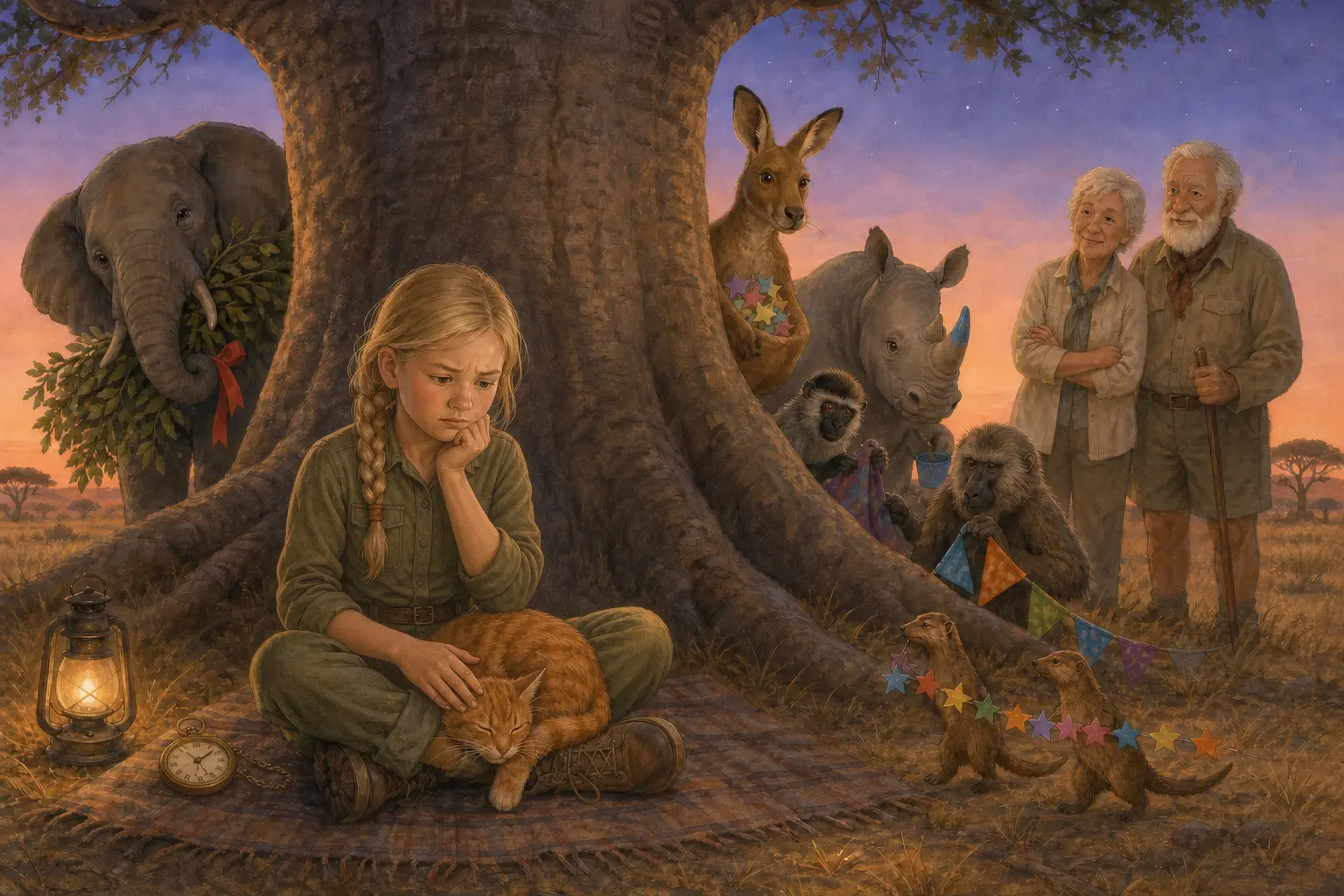
That afternoon, she sat beneath the baobab tree with Marmalade curled against her legs. The hands of Opi’s little travelling clock seemed to be moving more slowly than usual.
Lou-Anne watched the long hand.
It ticked forwards once.
Then it appeared to stop completely.
She leaned closer.
Tick.
“That took ages,” she muttered.
Marmalade opened one golden eye.
“Tomorrow is taking forever to arrive,” Lou-Anne told him.
Marmalade yawned. Cats did not worry much about birthdays. Every day containing a warm place to sleep and something pleasant to eat was already worth celebrating.
M’Pofo came through the grass carrying a bundle of leafy branches in his trunk.
“What are those for?” Lou-Anne asked.
“Shade,” he replied much too quickly.
“Shade for what?”
“For anything that might require shade.”
Lou-Anne narrowed her eyes.
Bright red ribbon was sticking out from between the leaves.
M’Pofo noticed it, turned around and walked away again.
A moment later, Kiera bounced past with her pouch looking unusually full.
“What are you carrying?” Lou-Anne asked.
“Nothing.”
Something inside the pouch squeaked.
Kiera looked down.
“Almost nothing.”
She hopped away before Lou-Anne could ask another question.
Ubejane emerged from behind the tree with blue paint on the end of his horn.
“Have you been painting something?” Lou-Anne asked.
“No.”
“There’s paint on your horn.”
Ubejane tried to look at it, which made his eyes cross.
“An unrelated incident.”
He hurried after M’Pofo.
Lou-Anne sighed.
Waiting was difficult enough without everyone behaving like members of a very badly organised secret society.
She picked up Opi’s clock again.
Tick.
“How can a day move so slowly?” she asked.
Omi was approaching along the path with a covered basket. She sat beside Lou-Anne and placed it carefully out of Marmalade’s reach.
“Is something troubling you?”
“I can’t believe I’ll be eleven tomorrow,” Lou-Anne said. “I’ve been waiting all week, but tomorrow never seems to get any closer.”
Omi smiled. “Birthdays are peculiar things. We wait and wait, and then they arrive as though they have surprised us.”
“What if I don’t feel eleven when I wake up?”
“How do you think eleven is supposed to feel?”
Lou-Anne considered this.
“Taller, perhaps. And wiser.”
“You might wake up a little taller,” Omi said. “Although I would not depend on it happening overnight.”
“And wiser?”
“That usually takes longer than one night.”
Lou-Anne rested her chin on her knees.
“It feels as if time is hardly moving. But the whole year went so quickly. My tenth birthday doesn’t seem very long ago.”
Omi nodded. “That is another strange thing about time. A minute can feel enormous while you are waiting, but a whole year can seem tiny when you look behind you.”
Lou-Anne picked up the clock.
“Why does it do that?”
“The clock does not,” Omi said. “Our feelings do.”
That sounded like something worth thinking about.
Before Lou-Anne could think very far, Nuru and Buhala raced around the tree. They were carrying a string of paper stars between them.
When they saw Lou-Anne, they stopped.
The stars dropped into the grass.
“We found these,” said Nuru.
“Lying around,” Buhala added.
“In a perfectly straight string?”
“Yes,” said both mongooses.
Vakawu swung down and landed between them.
“You two are terrible at secrets.”
“You told her there would be a cake,” Nuru protested.
“I said there might be a cake somewhere in the world. That is simply geography.”
Batenga appeared carrying a wooden spoon covered in pink icing.
Everyone stared at him.
Batenga stared at the spoon.
“I can explain.”
“You’ve been eating my birthday cake,” Lou-Anne said.
“Testing,” Batenga corrected. “It is a serious responsibility.”
Lou-Anne tried to look stern, but she began to laugh.
Soon everyone was laughing, even Ubejane, although he disguised his laugh as a cough.
Omi stood and picked up her basket.
“I think the preparations will be safer if Lou-Anne takes a walk with Opi.”
Opi arrived wearing his hat and carrying two small lanterns.
“A walk sounds like an excellent idea.”
Lou-Anne left the others to their suspicious activities and followed Opi towards the water hole. Marmalade came too, padding silently beside her.
The sun was already low. Golden light spread over the grass, and long shadows reached across the path.
“Do you remember the evening before you turned ten?” Opi asked.
“Not very clearly.”
“You told me you were worried about becoming ten because it had two numbers.”
Lou-Anne laughed. “That sounds silly now.”
“It did not feel silly then.”
They reached the water hole and sat on a smooth rock near the reeds. Tiny insects danced above the water, and a pair of frogs called to one another from opposite banks.
Opi handed Lou-Anne one of the lanterns, although it was not yet dark enough to light it.
“What was your favourite part of being ten?” he asked.
Lou-Anne had to think.
There had been so many things.
She remembered her first day at Savannah School and the report card everyone had celebrated. She remembered learning karate, trying to DJ at the village party and sailing on Omi and Opi’s lake. She remembered helping animals in storms, heat and muddy water. She remembered the Christmas markets, the Chilbi, the Namaqualand flowers and the little snow leopard in the mountains.
“I don’t think I can choose one thing.”
“Then choose three.”
Lou-Anne thought again.
“Learning new things. Helping someone when they needed me. And being with everyone.”
Opi nodded. “Those sound like good things to carry into eleven.”
“Can I carry ten with me?”
“Of course.”
“I thought birthdays meant leaving the old age behind.”
“You leave the number behind,” Opi explained. “You keep everything it gave you.”
Lou-Anne looked at her reflection in the water.
She still looked like herself.
Perhaps that was the answer. Tomorrow she would still be Lou-Anne, only with another year of stories tucked inside her.
As the light faded, Opi lit the lanterns.
“Now,” he said, “we should return before your friends accidentally reveal every remaining surprise.”
They walked back beneath a sky turning lavender and blue.
When they reached the baobab, the clearing looked almost ordinary. The ribbons, paper stars and mysterious leafy branches had disappeared.
M’Pofo was standing with an expression of exaggerated innocence. Kiera sat with her paws neatly folded. Vakawu and Batenga were nowhere near the picnic baskets, which was suspicious in itself.
“Everything prepared?” Opi asked.
“What everything?” said Vakawu.
Ubejane groaned.
Omi handed Lou-Anne a bowl of warm soup and a slice of bread. Everyone ate together beneath the first stars, but nobody mentioned the birthday preparations again.
Later, Omi and Opi said goodnight and returned to their house. The animals settled around the baobab. Lou-Anne lay beneath a light blanket with Marmalade curled beside her and M’Pofo resting nearby.
She closed her eyes.
Then she opened them.
“Is it nearly tomorrow?”
“Not yet,” M’Pofo said.
Lou-Anne closed her eyes again.
She counted twenty breaths.
“Now?”
“No.”
She tried counting stars, but Vakawu kept naming them incorrectly from his branch.
“That one is the Great Banana.”
“It is not,” said Ubejane.
“And those three form the Dancing Monkey.”
“They do not.”
“The stars can represent anything if you have imagination.”
“They can also represent stars,” Ubejane replied.
Lou-Anne laughed, but sleep still would not come.
“What if I stay awake until my birthday?” she asked.
“Then you will arrive at eleven feeling exhausted,” said Ubejane.
M’Pofo lifted his head.
“Would you like to know a secret about waiting?”
“Yes.”
“You do not always have to watch time pass. Sometimes you can let it carry you.”
“How?”
“Think of something peaceful. Listen to the Savannah. Let the minutes move without checking them.”
Lou-Anne put Opi’s clock inside her satchel where she could no longer see it.
She listened.
The grass rustled softly. Crickets sang near the roots. M’Pofo breathed with a deep, steady rhythm. Marmalade purred against her side.
Kiera began telling a quiet story about the moon travelling across the sky in a silver boat. Nuru and Buhala added tiny waves made from clouds. Vakawu insisted the boat needed a monkey captain, but his voice grew sleepier with every sentence.
Even Ubejane contributed.
“The captain should stop talking and steer.”
Lou-Anne smiled in the darkness.
Perhaps time had not slowed down after all. Perhaps she had been holding each minute too tightly, examining it and asking why it had not become tomorrow yet.
She loosened her thoughts.
The Savannah’s night-time song carried her gently away.
Some time later, Lou-Anne opened her eyes.
For a moment she did not know what had woken her.
The sky was pale gold. Birds were singing in the baobab, and a warm stripe of sunlight touched the grass.
Everyone had disappeared.
Then Lou-Anne noticed a trail of paper stars leading away from her blanket.
Marmalade was sitting at the beginning of the trail, wearing a small green ribbon around his neck.
“Is it morning?” she whispered.
Marmalade meowed.
Lou-Anne sat up.
“Does that mean I’m eleven?”
From behind the baobab came a thunderous cheer.
“Happy birthday, Lou-Anne!”
M’Pofo stepped out first, carrying a garland in his trunk. Kiera followed with flowers spilling from her pouch. Ubejane wore a blue ribbon around his horn, Vakawu and Batenga carried the cake, and Nuru and Buhala held the repaired string of paper stars.
Omi and Opi came along the path, smiling and waving.
Lou-Anne stared at them.
“But it was only just night-time!”
Omi hugged her.
“That is how birthdays arrive. Slowly for days, then all at once.”
Lou-Anne looked down at herself.
She did not seem taller.
She did not feel suddenly wise.
She felt warm, surprised and extremely happy.
“Do I look eleven?” she asked.
M’Pofo studied her carefully.
“You look exactly like Lou-Anne.”
“That,” said Opi, “is an excellent way to begin.”
Lou-Anne smiled at everyone gathered around her. Yesterday she had worried that eleven might arrive before she was ready.
Now she understood that she did not have to become a completely different person when a birthday came.
She could bring ten with her.
She could bring every lesson, every mistake, every adventure and every friend.
Time had not forgotten her, and it had not rushed past her. It had simply carried her forwards while filling her days with stories.
Lou-Anne took a deep breath of the bright morning air.
“Well,” she said, “if I’m really eleven, we had better celebrate.”
Vakawu lifted the cake.
“I have been saying that for hours.”
“You have been eating the icing for hours,” said Ubejane.
As laughter filled the clearing, Lou-Anne looked once more at the sunrise.
Eleven had arrived without warning.
But it had brought everyone she loved along with it.
And suddenly, being eleven felt exactly right.