
Story 43
Lou-Anne and the Eyes in the Water
11 minute read · Water adventure
The evening was warm and still as Lou-Anne and her friends made their way toward the water hole.
The sky was painted in soft gold and pink, and the first bats had begun to flicker through the air like little scraps of shadow. M’Pofo walked slowly beside Lou-Anne, his great ears flapping gently. Kiera bounded ahead and back, full of the kind of excitement that made it impossible for her to travel in a straight line. Vakawu swung through the branches above them, commentating on absolutely everything. Ubejane tramped along in his usual grumbling rhythm, and Marmalade padded close beside Lou-Anne’s boots.
“We haven’t been to the water hole in days,” Lou-Anne said. “I wonder who’ll be there.”
“Hopefully no one noisy,” said Ubejane.
“That rules out Vakawu,” said Kiera.
“It rules out some people,” Vakawu said, with great dignity.
When they reached the last stretch of grass before the water, Kiera suddenly froze.
So did Marmalade.
So did Lou-Anne.
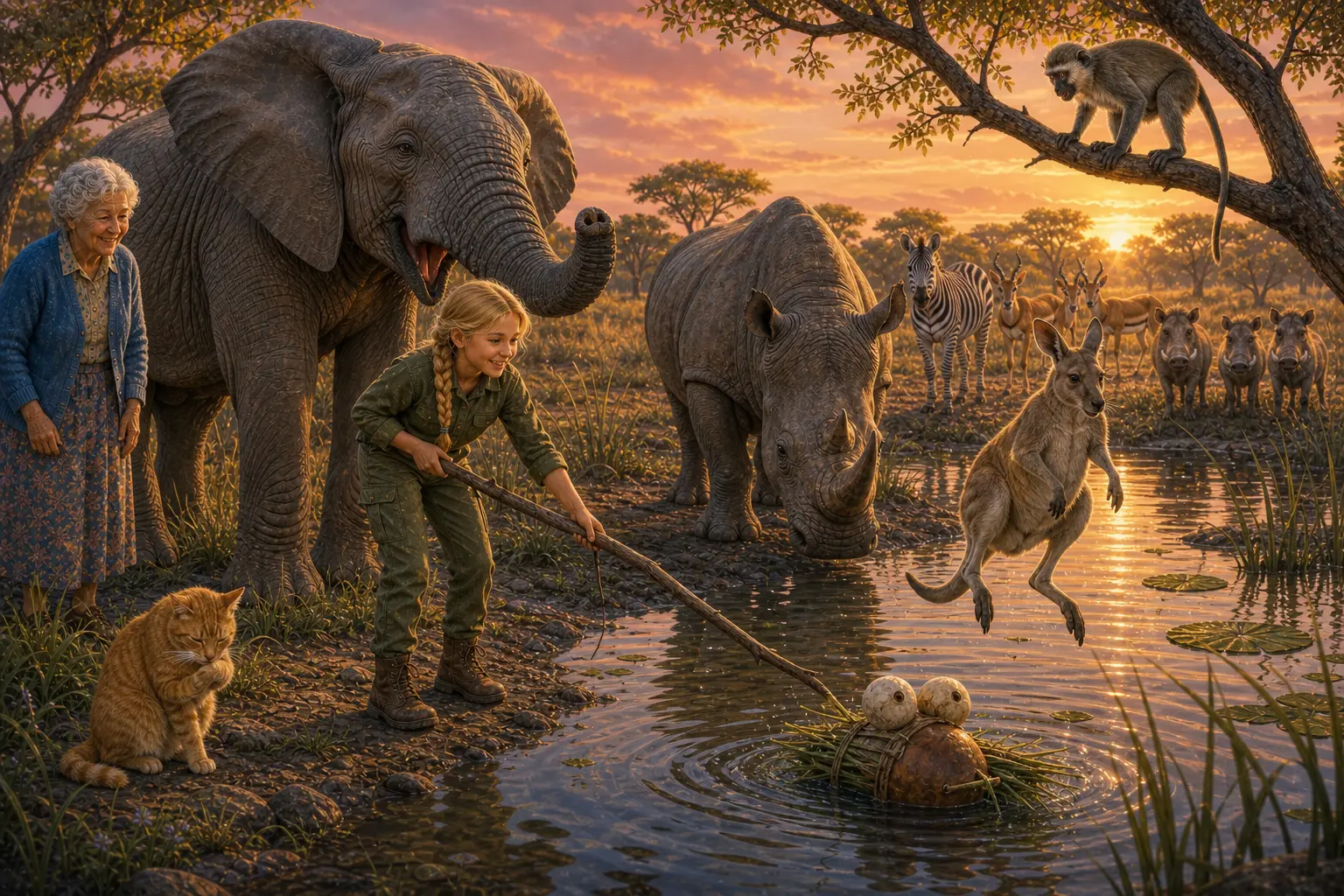
Out in the middle of the water hole, just beyond the reeds, two round eyes and a dark shape floated almost motionless on the surface.
Vakawu gave a strangled whisper from the tree above. “Crocodile.”
At once, everyone stopped.
Ubejane lowered his head. “I knew it.”
M’Pofo stood very still. “Back away slowly.”
Kiera took one careful hop backward. Marmalade puffed up to nearly twice his normal size, which would have been much more intimidating if he had been larger than a cat.
Lou-Anne stared at the water.
The eyes blinked.
Then the shape drifted a little nearer.
Vakawu gave a small squeak and scrambled higher into the branches.
“It’s definitely a crocodile,” he whispered. “This is a crocodile sort of situation.”
For a moment, nobody moved.
The water hole, which had seemed so peaceful only seconds ago, now felt full of danger. The frogs had gone quiet. The reeds rustled in the evening breeze. The floating shape stayed almost perfectly still again, except for the little ripples around it.
Lou-Anne swallowed. “Do crocodiles live here?”
“Not usually,” said M’Pofo.
“Not at all, as far as I am concerned,” said Ubejane.
Kiera’s ears drooped. “What if the other animals come to drink?”
That made Lou-Anne think fast.
“We need to warn everyone,” she said.
M’Pofo nodded. “Without causing a stampede.”
“Good,” said Ubejane. “Because stampedes are just organised panic.”
Vakawu was already swinging through the trees. “I’ll watch from above!”
“You’ll shout from above,” said Ubejane.
“That too!” Vakawu called back.
The friends began their careful warning.
Kiera raced to the edge of the path where the impalas usually came, telling them to keep back from the water for now. M’Pofo stood near the western approach, gently turning away a small family of warthogs with calm words and steady presence. Ubejane positioned himself near the reeds, looking so stern that no one argued with him. Lou-Anne and Marmalade stayed where they could watch the mysterious shape without getting too close.
Soon a little cluster of curious animals had gathered at a safe distance.
“What is it?” whispered a young zebra.
“A crocodile,” Vakawu declared from above.
“Maybe,” said Lou-Anne firmly. “We’re not sure yet.”
“We are extremely sure,” said Vakawu.
Lou-Anne narrowed her eyes at the water.
The floating thing had not moved much. In fact, the longer she looked, the odder it seemed.
“It’s small for a crocodile,” she said quietly.
“Baby crocodile?” suggested Kiera, which did not help anyone at all.
“Do baby crocodiles usually wear reeds?” asked M’Pofo.
That made Lou-Anne look harder.
He was right. Something green was trailing from the dark shape. And the “eyes” looked... strangely round. Too round.
Marmalade crept a few steps closer, tail twitching. He stared at the water, crouched, and then sat down.
“What is it?” Lou-Anne whispered.
Marmalade gave one short, doubtful meow.
He was not convinced.
And Marmalade, Lou-Anne had learned, was often annoyingly accurate.
“Stay here,” Lou-Anne said.
“I dislike the sound of that,” said Ubejane.
She bent down and picked up a long fallen branch from the grass. Very slowly, with M’Pofo close behind her, she edged toward the waterline.
The floating eyes watched her.
Vakawu made several faint, distressed monkey sounds from the branch above.
Lou-Anne took one more careful step, stretched out the branch, and nudged the dark shape.
At once it spun around.
Kiera yelped.
Vakawu practically launched himself into another tree.
Ubejane lowered his horn.
Then everybody stopped.
Because the “crocodile” was not a crocodile.
It was an old, half-sunken gourd tied to a broken bundle of reeds, with two round white seed pods stuck to the top like eyes.
For one full second there was complete silence.
Then M’Pofo began to laugh.
Not a rude laugh. A big, warm, rolling elephant laugh that started in his chest and rumbled out into the evening air.
Lou-Anne covered her mouth, then laughed too.
Kiera bounced straight into the air. “It’s a vegetable!”
Vakawu peered down from the branch. “That... is not a crocodile.”
“No,” said Ubejane flatly. “It is a puddle pumpkin.”
Marmalade sat down and began washing his shoulder, as if to say that he had known all along and would not be discussing it.
Once the laughing had calmed down, Omi, who had arrived just in time to see the truth revealed, smiled and shook her head.
“So,” she said, “what have we learned?”
Vakawu dropped down and tried to look wise. “That danger is sometimes made of gardening rubbish.”
“That,” said Omi, “is one version.”
Lou-Anne poked the floating bundle again with the stick. “And that sometimes things look scarier than they are.”
M’Pofo nodded. “Especially when you only see part of them.”
Kiera tilted her head. “So it was a misunderstanding.”
“A large one,” said Ubejane. “With witnesses.”
The young zebra, now much braver, stepped closer and peered at the gourd. “I thought it was terrifying.”
“It was very convincing,” Lou-Anne said kindly.
Omi sat down on a flat stone near the water. “It’s good to be careful,” she said. “But it’s also good to pause, look properly, and make sure fear is telling the truth.”
Lou-Anne liked that very much.
The friends dragged the soggy fake crocodile out of the water and set it on the bank, where it immediately looked much sillier.
Vakawu insisted on poking it with a stick just to restore his pride.
M’Pofo helped clear the broken reeds so they would not drift back again. Ubejane muttered that he had never liked that gourd from the start, despite having encountered it only moments earlier. Kiera told the warthogs and zebras that the water hole was safe again, though she could barely get the words out without laughing.
By the time the moon began to rise, everyone was drinking peacefully at the water hole as though the whole panic had never happened.
Well, almost everyone.
Vakawu kept glancing suspiciously at reflections.
“You do realise,” said Ubejane, “that your own face is not a water predator.”
“That remains to be seen,” said Vakawu.
As they walked home under the stars, Lou-Anne looked up at M’Pofo and smiled.
“I’m glad we didn’t just run away.”
M’Pofo’s ears flapped softly. “So am I.”
Marmalade brushed against Lou-Anne’s ankle. Kiera was still giggling every few minutes. Vakawu had already started retelling the story in a version where he had bravely protected everyone from the terrifying vegetable-beast. Ubejane did not bother correcting him because some foolishness, apparently, cannot be improved.
The Savannah night smelled cool and calm again, and the water hole behind them glittered peacefully in the moonlight.
And Lou-Anne thought that the best adventures were often the ones that began with fear and ended with laughter.
Especially when nobody had actually been chased by a crocodile.